-
Medea Norrington
V7Ds Death
Medea Norrington
V7Ds Death
Meddie
Rhiannon Worthington
Elizabeth Wollstonecraft
Justine Lavenza
Aubrey Hepburn
Maria Shellstrop
Thalia di Angelo
Nina Westenray
Vanessa Carter
Cassandra Richards
and many other aliases.
Female
25 (By Under Pressure)
27 (By Under Siege)
28 (By Under World)
38 (By the epilogue of Under World)
45 (By ND10)
130–135 lbs (59–61 kg)
5 feet 4 inches tall (162.5 cm)
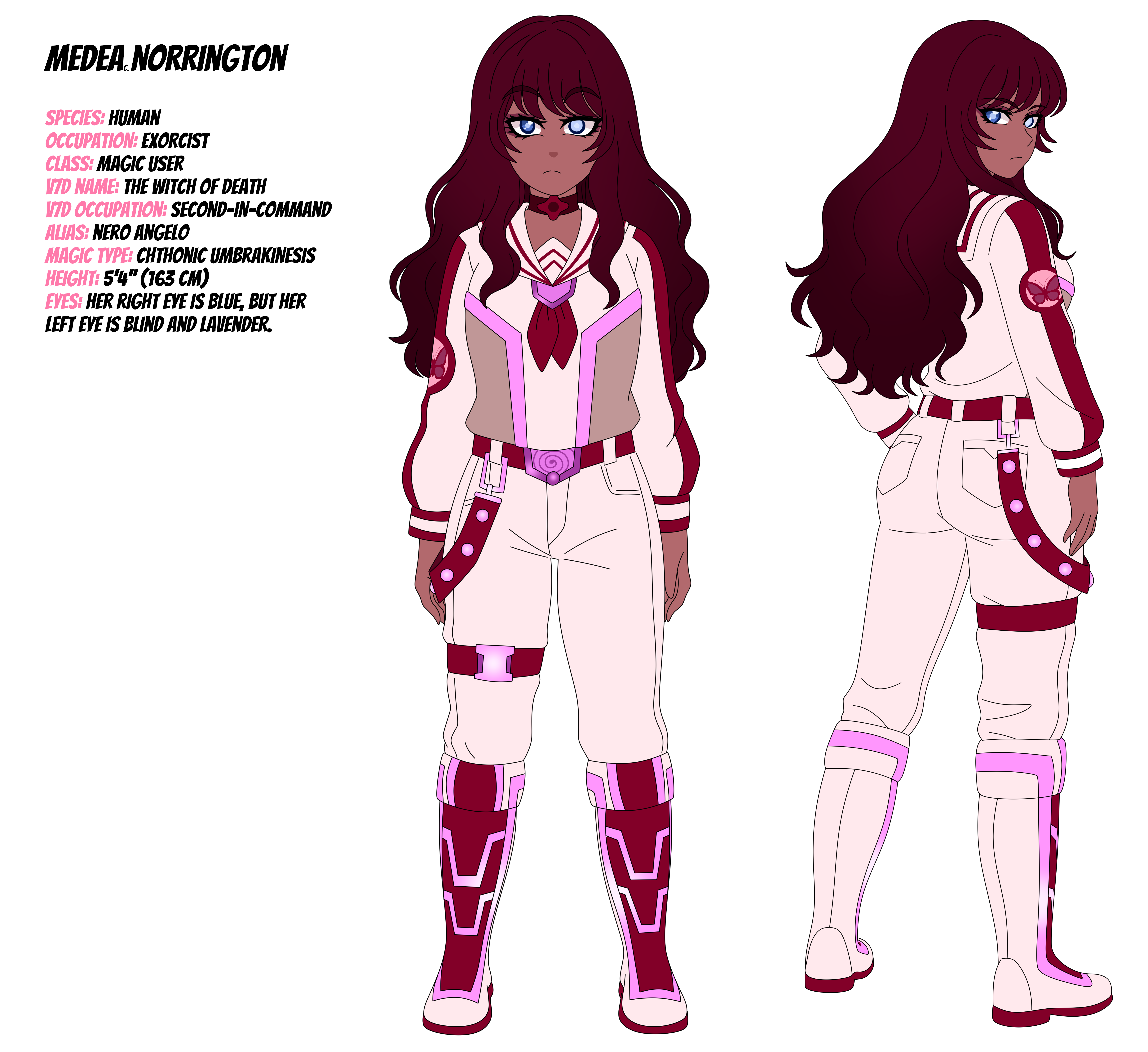
Medea has long, voluminous brunette hair that cascades in waves down her back.
The hair has a rich, deep color and is styled to flow freely, framing her face and shoulders.
Medea’s right eye is particularly striking—a vivid, deep blue that stands out sharply against her dark skin.
In contrast, her left eye is blind, it lacks the vivid pigmentation of the right. Instead, it's a pale, washed-out blue, with an even lighter, almost white center. This central area is often mistaken for her iris, creating a ghostly effect that sets it apart from the healthy eye.
Semi-Artificial Human
Her skin is a rich, medium-dark brown, giving her a warm and inviting appearance.
She has a well-defined, symmetrical face with a small, confident smile. Her features are sharp and expressive, with high cheekbones and a slightly pointed chin. She has a slender yet athletic build, with long limbs and a graceful posture.
Her main outfit consists of a a white jacket that fits snugly around her upper body. The jacket features red accents along the seams and edges, particularly around the shoulders and arms. The jacket has a high collar that partially covers her neck, with a red, triangular design in the center of her chest area.
There is a red patch or emblem on her left upper arm with a butterfly logo, adding to the uniform-like appearance of the outfit.
The cuffs of the jacket are also accented with red, creating a consistent color theme.
She wears matching white pants that fit closely to her legs, designed for both style and mobility.
There is a red strap or belt that runs diagonally across her right hip, providing an additional visual element and possibly functionality.
Her boots are tall, reaching up to just below her knees. They are primarily red with white accents, mirroring the design of her jacket and pants.
The boots have a wrestling gear design, with angular patterns and a secure fit that suggests they are made for action and agility.
Growing up, Medea always wanted to learn magic, have the knowledge to handle it properly, and win over Laurel even more so that she would bless her power even more.
After meeting and working with Warren, Medea's quest for magic was lessened (especially since she suspected that the sacrifice of one of her eyes would give her all the power she considered necessary), but she also felt deeply disturbed by everything she had done to acquire that power. As a result, she is now focused on making amends for her wrongdoings.
Even after Warren, she remains completely on the good side and uses her powers to punish wrongdoers. After learning about Warren Norrington's monstrous path in LA, she actively tried everything in her power to stop him.
She started to distance herself from people, her appearance got a lot scarier, she got irritable easily, and she didn't hesitate to use her abilities to harm those she deemed deserved it. If not for the V7D's influence and intervention, she would have remained a Butcher and done nothing else.
When Medea was a young girl, she was easily manipulated. Her thirst for knowledge and her curiosity about new magic led her not only to leave her home and friends but also to cause lots of misfortunes to many people.
As she ages, she becomes harder to control since, thanks to Warren's training, her desire to learn about magic has subsided.
She was a very laid-back youngster who seemed to be eager to trust others and who also enjoyed cracking jokes, even at her own expense. She had a sneaky side and would sneak out of the house to take bones and bodies from a nearby graveyard.
As a necromancer and favourite of a major deity like Laurel, Medea is well-educated and has a quick and curious mind, she's also shown to be a very natural sorceress.
However, due to the horrible experience of being under Warren's wing, Medea became a more violent, cold, and psychotic figure after spending a few years with the monster who spawned her. She also developed a more calculating gaze.
Nicoletta thought of her as having eyes like those of a former war prisoner; they seem powerful because they don't want to look vulnerable, but there is so much... sorrow behind them.
Medea hunts brutally and frequently uses extreme violence; she rarely kills her target until she has absolutely made them powerless and humiliated them; in fact, she even prefers to cripple the worst among them than killing them. However, this usually happens when she is working on tasks; after the assignment is through, she changes into a calm, and occasionally even approachable, lady.
Despite all the atrocities she experienced while living with Warren, Medea still retains a warm and compassionate attitude toward her loved ones, particularly her girlfriends Nicoletta and Miyuuki, who were essential in assisting her to recover from the PTSD Warren gave her and keeping her human side alive.
December 17th / 1990
Medea C. Norrington is the one-eyed umbrakinetic sorceress and the chosen champion of the goddess Laurel Nasuka. She’s a member of the V7D, where she goes by the codename Death.
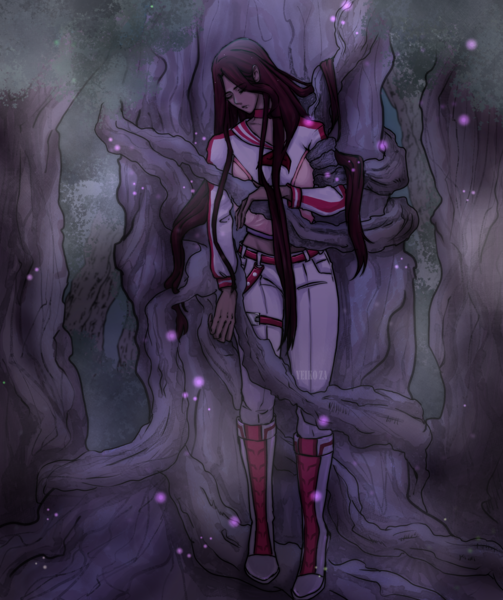
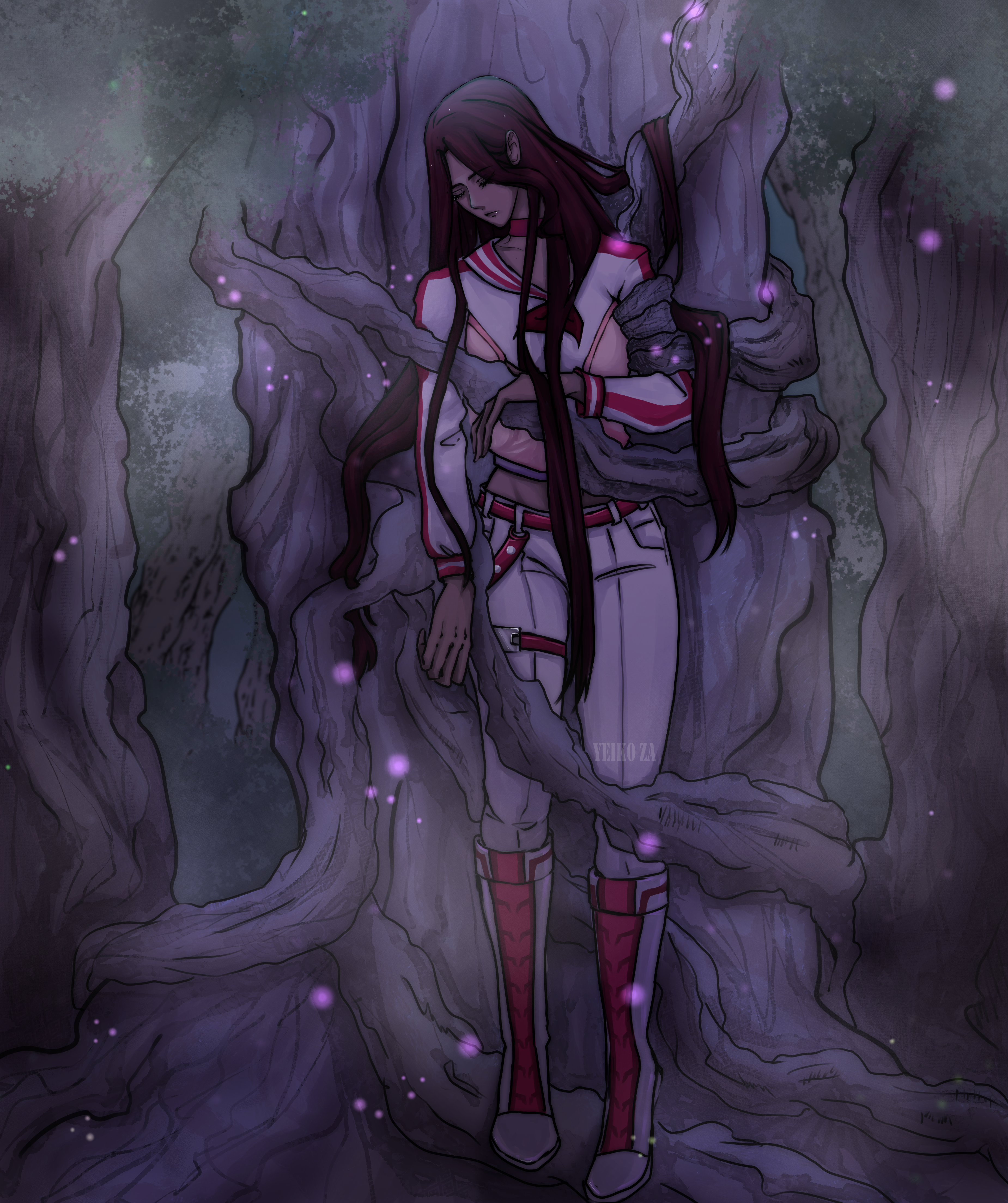
As the protagonist of Norrington’s Desire, Medea first appears when the V7D stumbles upon her in a state of supernatural suspended animation—bound to a tree, its branches wrapped around her like they’re trying to keep her locked in place.
After a series of unexpected events, she decides to tag along on their journey—partly to atone for past mistakes in her relentless pursuit of magic, and partly because she sees them as convenient tour guides while she searches for something in Italy…
Medea is a 25-year-old Egyptian woman, and at first glance, you’d probably think she’s the least threatening member of V7D. 5'4" of unassuming, delicate-looking frame, most would brush her off as harmless. Big mistake. Medea is a master of Umbrakinesis—a rare, refined form of darkness manipulation that might sound simple, but in practice? It’s absurdly powerful. Shadows are her playground, and she knows how to use them. Curse magic? She’s got it. Teleportation? Easy. Shadow tentacles to grab, restrain, or straight-up crush? That’s just her warming up.

View Full Gallery Experience
Check out our newly designed gallery page with larger images, lightbox viewing, and an overview section – perfect for sharing with others!
TRIVIA:
• Medea was named after Princess Medea from Greek Mythology, who, along with other mythical characters such as Circe and Morgan Le Fay, heavily influenced her character.
• Medea was also loosely based on Norse god Odin (both gave up one eye for magic, both have many aliases, both have numerous animal companions)
• Medea's favourite book is Joe Hill's Heart-Shaped Box.
• Due to an alleged ''glitch'' in their design, Medea, much like Eve, is face-blind. Faces just don't stick in her memory, but she's got a good enough grasp on voices, going as far as to notice impersonators.
• With the exception of canids, who are associated with Laurel, the Dragon God of the Underworld, animals are scared of Medea because she gives off a deathly scent.
• Medea often seeks solace by playing her flute, especially when she wanders alone or explores mausoleums. The act of playing music brings her a sense of calm and relaxation.
---CHTHONIC ABILITIES---
Chthonic Umbrakinesis — The Sovereign Shadowcraft of the Underworld
Class: Divine-Magical Sovereignty / Umbral Dominion
Origin Type: Underworld Pact-Bound Bestowal (Champion-exclusive)
Threat Tier: High-Moderate — with extreme lethality under specialization
Umbrakinesis, in its purest form, is the magic ability to conjure, mold, and command shadows—manifestations of the absence of light. Yet, the Chthonic or Underworld variant transcends this mundane manipulation, wielding darkness not merely as a lack of photons but as a profound metaphysical force rooted in the very fabric of death, oblivion, and the boundary between worlds.
This power is bestowed exclusively upon the Chosen Champion of the Underworld’s resident Ruler—an honor (or curse, depending on who you ask) conferred once per generation—granting mastery over shadows as both physical phenomena and primordial cosmic energy
Core Nature & Mechanics:
Dual-Aspect Darkness:
The Chthonic wielder, in this case Medea, commands shadows on two intertwined planes:
• Physical Shadows: The tangible absence of light, manipulated through the control of photon flow, refraction, and occlusion, allowing creation of solid shadow constructs, cloaking fields, or shadow tendrils that can interact physically with matter.
• Metaphysical Darkness: A deeper, ethereal substance that embodies death, oblivion, and the unknown. This “darkness” is akin to a dense, intangible energy field permeating existence’s margins, capable of sapping life force, severing spiritual connections, or warping reality locally.
Shadow Mass & Gravity:
Drawing from the underworld’s primal void, shadows under this power possess an unusual mass-effect—though intangible, their concentrated density distorts light paths and gravity subtly, creating localized gravitational wells that can slow or trap opponents. This gives the shadows a pseudo-physical “weight” despite their intangible nature.
Medea’s application of this ability is refined and control-based, leaning heavily toward defensive capabilities, terrain alteration, and strategic misdirection. Its abilities include:
UMBRAWARD
Class: Defensive Umbrakinetic Construct (Barrier/Force Redistribution)
Origin Type: Chthonic Umbrakinesis (Champion Bestowal)
Threat Tier: Moderate–High (scales with Medea’s concentration and available shadow density)
Threat Level: Moderate to High (Defensive Supernatural Utility)
Umbraward is not mere darkness—it is massified blackness. Medea condenses ambient shadow into a semi-physical medium by forcing it into high-tension umbral states, which behave like viscous, glassy fluids under control but resist and redistribute force like reactive armor.
These barriers aren't solid in the traditional sense; instead, they operate on three metaphysical principles:
1. Umbral Density Field (UDF):
• Shadows, when concentrated through Medea’s will, behave like compressed force-absorption membranes. These membranes scale in toughness with emotional pressure and external light levels—darker environments yield stronger constructs due to higher “shadow availability.”
- Material State: Appears as translucent black glass or mist, but behaves like slow-reacting ferrofluid—dense, heavy, and malleable.
- Elastic Yield: When struck, the barrier deforms elastically, absorbing kinetic energy and distributing it across its structure like a non-Newtonian surface.
- Partial Phase Shift: At peak tension, Umbraward exists between physical and metaphysical states—allowing it to disrupt magical forces as well as physical ones.
2. Ricochet Geometry:
The barrier is not flat or static—it curves, pivots, or angles based on Medea’s hand gestures or emotional focus. This allows it to redirect force rather than simply block it.
- Blunt spells may be rebounded.
- Projectiles can be deflected if timed precisely.
- It is most effective against wide-area or predictable attacks.
The surface can form paraboloids, funnels, crescents, or even concave flares, shaped intuitively like a shifting lens of darkness that refracts force instead of light.
3. Shadow-Lag & Deployment Time:
Umbraward cannot be cast instantly because shadows must first be gathered and condensed. Medea requires a minimum of 0.4 to 0.6 seconds to "spool" a proper defense unless she's already prepared.
- Requires ambient shadow or spiritual darkness as a catalyst.
- In broad daylight or well-lit environments, the casting delay increases unless she's carrying a personal shadow anchor (such as her own body, cloak, or a cursed artifact).
Drawback:
• Prep-Dependent: Surprise attacks, bullets, or instantaneous magic can breach her defenses before the barrier forms.
• Mental Focus: Shaping complex geometries (like reflective cones or kinetic traps) requires intense concentration and emotional control—emotional spikes can destabilize it.
• Lightborn Magic Penetration: Magic that radiates, rather than impacts (like searing beams or solar blessings), can bypass or erode the ward faster than kinetic or shadow-based spells.
BLACK VEIL BRIDE
Class: Applied Umbrakinetic Technique (Stealth/Light Refraction)
Origin Type: Chthonic Umbrakinesis (Champion Bestowal)
Threat Tier: Moderate (scales to High in environments with strong ambient shadows/light interplay)
Black Veil Bride is a stealth-specialized umbrakinetic technique that bends ambient light using tightly controlled shadow refraction. Rather than conventional invisibility, it creates a cloak of visual distortion that warps outlines, disperses reflective light, and conceals movement, making Medea exceptionally difficult to detect.
Black Veil Bride relies on two overlapping principles:
• Refractive Shadow Manipulation: Altering the path of photons to bend around the user.
• Thermal Signature Suppression: Siphoning away bio-heat into umbral folds to prevent detection via infrared, aura-sight, or divine senses.
Core Capabilities:
• Medea can blend into surrounding darkness, becoming indistinguishable from her environment when still or moving at controlled speeds. This makes the technique ideal for infiltration, silent tracking, or ambush positioning.
• The cloak can be extended to one additional individual in physical proximity, allowing for paired covert operations or assisted escapes—though this increases the strain on Medea’s system.
• The technique scales with environmental lighting—growing more potent in deep shadows or during nighttime conditions. When combined with other shadow constructs or saturation zones, it becomes extremely difficult to counter through conventional means.
Drawback:
Thermal Drain
To keep her outline blurred and her presence suppressed, Black Veil Bride requires constant energy input to both pull in ambient light and suppress her own thermal signature. This causes her internal body temperature to plummet—like wrapping herself in spiritual dry ice.
- Symptoms: Numb extremities → Tremors → Slowed heart rate → Temporary blackout.
- She risks death by metaphysical hypothermia if used too long.
Detection Risk
While traditional eyes may be fooled, anyone with:
- Thermal optics (which pick up body heat despite optical illusions)
- Magical sight (which perceives aura or shadow fluctuation)
- Trained perception (those attuned to tracking distortions in motion)
Can potentially notice shimmering, rippling, or “dead silence” around her presence.
RIPTIDE
Class: Adaptive Shadow Armor (Mobility/Defense Hybrid)
Origin Type: Chthonic Umbrakinesis (Champion Bestowal)
Threat Level: Moderate to High (Tactical - Mobility and Durability Enhancement)
Riptide envelops Medea in a second skin of semi-sentient shadow, forming a responsive, close-fitting armor that adapts to kinetic threats and suppresses noise. The construct flows with her movements like liquid, dynamically reinforcing itself against ballistic strikes, explosive force, or hostile terrain—allowing her to traverse active warzones or infiltration routes with near-spectral grace.
Core Capabilities:
Ballistic and Concussive Resistance:
The armor tightens along the vector of impact, forming a high-tensile, multi-layered shadow weave that disperses energy. It doesn’t nullify bullets or fire outright—but slows, diffuses, and redistributes the force over a broader surface.
• Especially effective against blunt trauma, shrapnel arcs, and explosive force cones.
• Partially breathable: it vents metaphysical pressure (e.g., magic, heat) to avoid overloading.
Acoustic Concealment:
By manipulating micro-surface vibrations, Riptide actively dampens footfall, breath resonance, and rustle by nullifying the aetheric “ripple” Medea would normally produce.
• Ideal for stealth infiltration through unstable ground or urban warzones.
• However, ambient sounds outside the veil are also muffled to Medea herself (see Drawbacks).
High-Mobility Threat Response:
Unlike rigid armor, Riptide flows in sync with Medea’s every move, redistributing its mass around active muscles, pivots, or expected strain points. This lets her:
• Sprint, vault, or dive through obstacles.
• Brace automatically for concussive waves (e.g., explosives).
• Fight close-quarters without the weight or clatter of metal.
Drawbacks:
Auditory Dampening – Sensory Isolation Cost:
While Riptide erases her from detection, it also siphons away external sound via negative resonance cancellation. Medea experiences the world as muffled, dulled, and emotionally flattened, which:
• Blinds her to approaching footsteps or murmurs.
• Makes verbal coordination in groups difficult or dangerous.
This forces her to rely heavily on vision and intuition when using Riptide.
Cognitive Load & Construct Interference:
Riptide is not passive armor—it demands attention to maintain its reflexive responses.
• Running Umbraward (a perimeter defense) or another complex shadow construct at the same time splits Medea’s will, which:
• Slows Riptide’s reaction speed,
• Thins its protective density,
• And delays metaphysical shock absorption.
SHADOW FEINTS
Class: Illusory Shadow Projection (Deception / Tactical Utility)
Origin Type: Chthonic Umbrakinesis (Champion Bestowal)
Threat Tier: Low–Moderate (situational—devastating against reflex-driven opponents, but limited against seasoned or non-visual combatants)
Shadow Feints is a mid-tier umbrakinetic illusion technique where Medea rapidly reshapes local shadowfields into motion-mimicking visual decoys. Rather than creating autonomous entities, this technique warps ambient darkness and residual light into ephemeral silhouettes that emulate gesture, posture, and motion blur—perfect for breaking line-of-sight, tricking reflexes, and baiting overcommitment.
Core Capabilities:
• Illusory Movement Clones: Medea can generate one to three shadow-based decoys of other people, each capable of mimicking their gestures in near-perfect synchronization or following pre-determined routes. These feints simulate realistic weight and momentum, making them difficult to distinguish at a glance.
• Dynamic Deployment: These illusions can be triggered in the middle of combat, often at the moment of an attack or retreat, confusing opponents and breaking line-of-sight, forcing them to hesitate or strike empty space.
• Environmental Synergy: The effectiveness of Shadow Feints is amplified in dimly lit or chaotic environments, where depth perception and visual clarity are already compromised. In such conditions, the feints appear especially convincing and disruptive.
Drawback:
• Shadow Feints are purely visual phenomena—they lack any physical substance and dissipate immediately on contact or if pressured. Skilled or experienced foes may quickly recognize the illusions after a failed strike, especially if they probe with caution or notice their inability to cast accurate shadows.
• These constructs cannot fully replicate Medea’s detailed appearance, only people she can see herself; meaning they cannot impersonate her for the purpose of full-body disguise—only suggestive movement or outline.
ENTANGLE
Class: Shadow Restraint (Control / Crowd Management)
Origin Type: Chthonic Umbrakinesis (Champion Bestowal)
Threat Tier: Moderate (effective in multi-target control and setup plays, but less effective against overwhelmingly strong or incorporeal foes)
Entangle is a non-lethal restraint technique in which Medea manipulates ambient shadows into semi-tangible tendrils—like tethers of viscous smoke—that lash out to immobilize, trip, or anchor enemies. Designed for precision over brute force, Entangle excels in crowd control scenarios, pursuit interruption, and setting up vulnerable opponents for follow-up attacks by Medea or her allies.
Core Capabilities:
• Multi-Target Restraint: Medea can manifest multiple bindings simultaneously, each targeting a different limb, weapon, or movement vector. These tendrils act with whip-like precision and behave almost organically—responding to threat motion and predicted escape routes.
• Environmental Synergy: The ability’s effectiveness scales with terrain and ambient light. Confined or dimly lit spaces enhance control, allowing shadows to travel further and coil tighter. Strategic use of terrain—like doorframes, corners, or debris—can increase the odds of successful entrapment.
• Anchor Amplification: For stronger restraints, Medea can root her own shadow to the ground, creating a fixed tether point that boosts the bind’s grip strength—useful against larger or highly mobile targets. This rooting makes it harder to pull free and can even stop charging enemies mid-stride.
Drawback:
• Entangle is not unbreakable—targets with substantial strength, mass, or weaponized momentum can break free with enough effort or time.
• More critically, rooting Medea’s own shadow severely limits her movement during the bind. If the restraint is resisted or countered, she may be left exposed or unable to reposition quickly. Tactical awareness and timing are key to deploying this ability without compromising her own safety.
VEILED
Class: Sensory Severance (Cognitive / Perceptual Assault)
Origin Type: Chthonic Umbrakinesis (Champion Bestowal)
Threat Tier: Moderate–High (Situationally Extreme vs. sight-reliant targets; diminished against multisensory combatants or beings with extrasensory perception)
Veiled is a mid-tier precision spell within the broader field of chthonic umbrakinesis. Rather than creating external darkness, this technique projects concentrated metaphysical shadow directly into a target's neurological vision pipeline, forcibly severing the subject’s brain from its visual input.
Unlike standard blindness, Veiled bypasses the eyes—it overlays a conceptual null over the optic signal itself, creating a sensory void that the brain interprets as an absolute, suffocating darkness.
Core Capabilities
Neuromantic Occlusion Field:
Medea generates a "veil" by condensing underworld-bound shadow into a coherent aetheric lattice tuned to the oscillation frequency of visual perception—essentially blinding the target at the data interpretation layer rather than through brute obstruction.
• The shadow interfaces with the optic nerve, lateral geniculate nucleus, and visual cortex, silencing signal transduction through harmonic nullification.
• This feels to the victim like being dropped into a black pressure-vacuum, often accompanied by nausea, vertigo, or sensory panic as the brain struggles to reorient.
Photon Memory Collapse
Rather than just covering the eye, the magic "undoes" light’s presence in the target’s perception zone—effectively retroactively erasing visual stimulus for the duration. Light enhancement tech (thermal optics, magical sight) may fail due to the veil operating on the target’s cognition, not their hardware.
Drawback:
• Concentration & Line-of-Sight:
Initiating the occlusion requires Medea to directly see the target and maintain visual clarity for the duration of spellcasting. Obscured targets (in smoke, behind cover, out of her perceptual reach) cannot be veiled.
• Temporal Constraint: Blindness typically lasts 10–30 seconds, influenced by the target’s magical resistance, willpower, or cognitive fortitude. Prolonged application creates diminishing returns as the mind begins compensating for the void or developing resistive echoes.
• Repeated use on the same target has diminishing returns unless paired with physical restraint or mental fatigue.
• Effectiveness Scale: The technique loses efficacy against:
- Individuals trained to fight blind or without sight.
- Targets who rely on alternate senses (echolocation, clairaudience, vibrational tracking).
- Environments of intense natural light, which create spatial pressure that resists the null-field’s coherence..
SHADOW BLOOM
Class: Cataclysmic Burst (Area-of-Effect / Gravitational Shadow Collapse)
Origin Type: Chthonic Umbrakinesis (Singularity Invocation)
Threat Tier: High (Situationally City-Level Catastrophic; local annihilation radius highly dependent on environmental shadow saturation)
Shadow Bloom is Medea’s most formidable and resource-intensive technique, weaponizing the totality of ambient shadow within her immediate environment. By collapsing these dispersed shadows into a single, high-density core, she unleashes a devastating gravitational pulse of shadow energy centered on her location. Shadow Bloom doesn’t just gather shadows—it collapses the local dark into a singularity-like core, releasing it violently outward.
Process:
I. Absorption Phase: Umbral Infall
Medea initiates Shadow Bloom by invoking a gravity-bind ritual designed to absorb not just ambient darkness, but all “negative” spatial phenomena within a variable radius (50 to 150 meters, depending on the availability of shade and metaphysical conditions). Shadows from alleyways, under benches, beneath shoes—all of it is drawn in.
She does not only gather visual shadows, but draws in:
• Conceptual Darkness — absences of presence: fear, grief, uncertainty, silence.
• Spatial Occlusions — blind spots in perception, mana “dead zones,” and folded interior spaces.
• Emotional Voids — unspoken despair, psychic absences, or lingering death-aspect aether.
This collapsing mass of dark is pulled inward as if responding to her heartbeat, compressing into a spiraling, slow-orbiting cluster beneath her sternum, forming a slow-orbiting vortex of dark matter.
The shadows behave as quasi-aetheric particles with a manipulable "mass" via gravitational umbrakinesis. As they spiral inward, they generate increasingly dense spatial curvature around her form.
Environmental Effects:
• Space near Medea visibly bends—light warps, air ripples, and a deepening silence falls.
• Dust, shrapnel, and loose objects are pulled toward her in tightening arcs.
• Pressure builds in the skulls and lungs of nearby beings—mimicking early vacuum trauma.
• Even spiritual or spectral entities feel a dragging sensation toward the umbral core.
Like a forming black hole, the shadows are pulled into a magical gravity well.
II. Compression Phase – Center of Gravity
Once the mass of shadow reaches critical threshold, it condenses into an unstable umbral singularity housed just beneath Medea’s sternum. She enters a trance-like state of absolute gravitational focus, becoming:
• A conduit for the singularity's weight and shape.
• A temporary anchor of warped metaphysical space.
This phase represents the most dangerous moment for Medea: she cannot move, speak, or cast other spells. Her shadow body is stretched thin between containment and collapse.
Phenomena Observed:
• Projectile Curve: Incoming weapons arc off-target, caught in skewed gravity.
• Visual Lensing: Targets around her appear blurred, elongated, or ripple like underwater phantoms.
• Temporal Anomalies: Microscale time dilation causes brief desyncs—heartbeat skips, footsteps stutter, and spells misfire a moment too late.
• Shadow Convergence: All light is drained toward the core, causing an eerie crown of thorns to form around Medea’s head.
III. Detonation Phase: Inversion Pulse
The core reaches its critical density. Rather than collapsing further, the singularity undergoes polarity inversion—from pull to push. The gravitational axis is forcibly reversed, unleashing a reverse aetheric pulse that detonates outward.
This is not an explosion of matter—it is the forced evacuation of gathered conceptual darkness, now weaponized as mass-displacement.
Effects of the Inversion:
• A violent radial shockwave hurls enemies backward—equally effective against physical, spectral, or magical bodies.
• Magical constructs flicker and burst—wards collapse, tracking spells destabilize, and summoned entities are forcibly unsummoned.
• Mana perception is scrambled; Casters within the blast suffer magical “vertigo” — perception fuzzes, spell matrices collapse, and headaches or nausea onset immediately.
• Shadows are erased across the terrain, causing daylight-like exposure for several seconds—followed by residual eclipse flickering.
• Sensitive beings may vomit, seize, or blackout from cognitive pressure differentials.
• In the Underworld or shadow-rich domains, this spell scales catastrophically. When fully unleashed in the Underworld proper, Shadow Bloom had a gravitational displacement comparable to a tactical strike across the breadth of a small country—restructuring terrain, annihilating entire cursed biomes, and leaving a permanent eclipse scar.
Drawback:
• Stationary Vulnerability:
Medea is immobile during Compression Phase; if interrupted prematurely, the gathered core destabilizes, leading to internal backlash—causing severe gravitational trauma to her nervous system.
• Energy Drain:
The sheer exertion of Shadow Bloom comes at a steep physiological and neurological cost:
• Immediately after release, Medea experiences severe sensory disorientation: partial blindness, vertigo, audio dampening, and impaired balance.
• Fine motor control becomes unreliable, making it difficult for her to cast precise spells or engage in close combat for roughly 30 seconds.
• In this recovery window, she becomes exceptionally vulnerable, and must rely on allies, summoned constructs, terrain advantage, or pre-laid traps to cover her retreat or conceal her presence.
• Additionally, Shadow Bloom cannot be cast in areas devoid of natural or magical shadow—such as Cult of Anima sanctums, consecrated ground, or daylight-drenched plains—limiting its usability outside of certain biomes or prepared battlegrounds.
• Geomancers or barrier mages might anchor themselves and allies, weathering the pulse.
And if you’re wondering what Umbrakinesis has to do with gravity—after all, Gravitokinesis is a completely separate magical discipline—well, that’s where things get interesting.
Once a practitioner like Medea reaches an advanced level of mastery, her control over darkness extends far beyond manipulating shadows. She begins to alter the density, cohesion, and presence of darkness itself—pushing into territory where gravitational mechanics start to echo.
Because if darkness isn’t just the absence of light, but rather the weight of the unknown, then gravity isn’t a side effect. It’s the most honest expression of that truth.
It's a form of magical gravity, not Newtonian force—so it’s less “Medea can control planets” and more:
“Medea collapses meaning. Medea can crush perception. Medea is the weight of the inevitable end.”
Which is very, very Chthonic.
ZONE DENIAL / SHADOW SATURATION
Class: Environmental Domination (Persistent Field Manipulation)
Origin Type: *Chthonic Umbrakinesis (Territorial Infusion)
*Threat Tier: Moderate–High (Escalates with Duration; synergizes lethally with other techniques)
Shadow Saturation is usually what follows Shadow Bloom. This ability allows Medea to gradually convert any contested space into a hostile, lightless environment that favors her tactics. By seeping umbral energy into the air, walls, and terrain, she floods the area with supernatural shadow, creating a kind of expanding twilight field that chokes visibility and disrupts normal perception.
Core Capabilities:
• Shadow Flooding: Through sustained presence or focused casting, Medea begins to saturate the environment with shadow, slowly erasing natural and artificial light sources within the area. Visibility diminishes in layers, turning once-familiar surroundings into a dim, shifting maze.
• Spatial Compression: Victims within the zone report an increasing sensation of constriction, as if the physical space around them is shrinking. This is not a literal warping of dimensions, but a psychosomatic pressure that mimics claustrophobia and limits free movement.
• Psychological Dissonance: The deeper one is drawn into the saturation zone, the more their mental clarity begins to erode. Even experienced warriors and spellcasters start to feel irrational dread, confusion, and heightened paranoia. Communication becomes erratic, and coordinated efforts quickly break down.
• Breath Restriction: Though not inherently toxic, the heavy shadow-laden air feels thick and oppressive, as if the lungs are being coated in smoke. This leads to shallow breathing, rising panic, and physical fatigue over prolonged exposure—especially dangerous for heavily armored or magic-reliant foes.
Drawback: The process of full saturation is gradual, not immediate. It takes time—anywhere from a few minutes to several, depending on the size of the battlefield—for Medea to completely dominate the space. During the early stages, fast-moving or highly aggressive enemies can exploit her focus and tempo before the zone reaches critical density.
AVENGERs SEVENFOLD
Class: Supreme Defensive Invocation (Umbraward Ascendant)
Origin Type: Chthonic Umbrakinesis (Protective Invocation / Null-Seal Geometry)
Threat Tier: High (Situationally Lethal—primarily defensive, but nullification makes it battlefield-defining)
The Avenger's Sevenfold is Medea’s pinnacle defensive invocation and a direct evolution of the Umbraward ability: A rotating array of metaphysical barriers, each representing a unique magical property and bound by a greater master seal. Once cast, it forms seven concentric, semi-translucent discs of shadowglass, orbiting her in a slow celestial pattern like dark planets around a sun.
Core Capabilities:
🜁 Layered Shield Matrix:
Each of the Seven Seals represents a principle of magical or physical nullification. When an incoming threat hits one, the seal fractures and shatters, but removes a specific threat property as it breaks.
Seal I: Kinetic Bleed – Absorbs physical force (blows, bullets, brute strikes).
Seal II: Pressure Diffusion – Dampens shockwaves, explosive force, or concussive bursts.
Seal III: Entropic Delay – Slows time-based or speed-focused attacks (e.g., supersonic projectiles, quick-cast spells).
Seal IV: Cursebreaker – Cancels lingering afflictions (bleeds, poisons, hexes).
Seal V: Magical Phase-Shift – Forces phantasmal or spiritual attacks into material form, rendering them disruptable.
Seal VI: Dimensional Anchor – Blocks teleportation spells, banishments, or spatial folds aimed at Medea or her vicinity.
Seal VII: Null Sigil – The final and central disc, it erases residual energy with pure anti-force, leaving nothing to breach.
Area Protection:
While centered on Medea, the Seal expands to a radius of 3–5 meters, offering protection to nearby allies. Ideal for when Medea uses it for the first time: The Siege.
Synchronized Break Pattern:
The shields do not vanish all at once. Instead, they break sequentially, each triggering a ripple of light and shadow, visually tracking the spell’s disintegration across each arcane layer.
Passive Spell Record:
The Seals “remember” the last spell they blocked. If Medea casts the same spell shortly after, casting time is halved, as the magic has been partially stored in the seals' memory lattice.
Drawbacks:
Sequential Fragility: Once a seal is broken, it does not regenerate. A sustained barrage can wear down all seven layers quickly if not mitigated or countered.
Preparation Cost: The invocation requires a minimum 3-second casting window and Medea must remain stationary during this phase. Interruptions before the seventh layer is formed result in an incomplete—and thus unstable—barrier.
Anchoring Limitation: Medea must anchor the Seal to a static position (usually herself), making rapid movement or teleportation disrupt the rotation and integrity of the matrix.
Homefield Advantage: The Avenger's Sevenfold is only viable in the Under World. Its principles are anchored to that realm’s metaphysical foundation, where shadow has density and soulstuff can form reactive substrates. In the Upper World, no material is stable or dark enough to hold the full structure. Medea can, at best, summon one or two seals at a time using concentrated effort and a personal shadow source. In sunlight or sacred ground, the spell fails completely.
WEAPONIZED FATIGUE
Origin: Chthonic Cursecraft (Umbrakinetic Drain)
Class: Attrition / Battlefield Control
Threat Tier: High (Anti-Sustain / Prolonged Engagements)
With this ability, Medea is able to siphon heat and stamina directly from her opponents using their own movement against them. The effect is subtle at first—barely noticeable—but grows more debilitating the longer a target remains active in her shadow’s reach.
Core Capabilities:
• Energy Drain: By channeling shadow along the contours of a target’s body, Medea gradually leeches thermal energy and physical stamina, inducing a creeping cold and a sense of inexplicable exhaustion.
• Progressive Exhaustion: The drain accelerates in response to exertion. The more the victim runs, fights, or casts spells, the more energy is siphoned, the harder they struggle, the faster they burn out. Within minutes, even elite combatants may find themselves sluggish, shivering, and gasping for breath.
• Stabilized State: Medea herself remains largely unaffected by the ambient toll. Her control over the flow of umbral energy allows her to remain composed, mobile, and sharp, making her especially dangerous in drawn-out engagements where stamina becomes the deciding factor.
Drawbacks:
• Proximity Dependency: The technique requires the target’s shadow to remain connected—either through continuous proximity or sustained shadow contact. Opponents who stay in motion, change elevation frequently, or fight under strong, shifting light sources can break the link and reduce the effectiveness of the drain.
• Shadow Backlash: Rapid or excessive draining can result in a backlash, temporarily causing Medea to experience dizziness, chills, or disorientation as her own energy is siphoned in the process..
NECROMANCY:
Origin: Chthonic Patronage (Queen of the Underworld’s Boon)
Class: Soul Manipulation / Death Command
Threat Tier: High to Extreme (Situational, Scale-Dependent)
Medea's secondary magical domain revolves around commanding death, manipulating the dead, the death-force, and souls. As the chosen champion of the Queen of the Underworld, her powers can serve various purposes—whether raising the dead, manipulating souls, or exerting influence over death itself. Medea’s necromantic abilities can be wielded for benevolent purposes, darker manipulations, or even neutral, pragmatic uses depending on her goals.
DIVINATION
Origin: Chthonic Communion (Spirits of the Underworld)
Class: Foresight / Knowledge Extraction
Threat Tier: Variable (Low to High, depending on spirit cooperation)
Medea's divinatory powers allow her to summon spirits into the world temporarily, either as ghostly apparitions or whispers bound to the shadows. These spirits offer insight into hidden truths, forgotten memories, or grant temporary access to their knowledge. Medea can call upon them for guidance, but their cooperation is not guaranteed, and she must carefully navigate their will.
Core Capabilities:
Spirit Summoning:
Casting: Medea enters a still state and opens her perception. Her necrokinetic aura fluctuates to emit an emotional “ping,” drawing in spirits resonating with that frequency.
Manifestation: A spirit must be anchored in shadow, appearing as a distortion in the environment—objects shift subtly, temperature drops, light bends oddly.
Interaction: Communication is like mediumship, filtered through emotional cues, metaphor, or fragmented sensory memory.
Insight Borrowing:
• The more aligned Medea is emotionally or psychologically with the spirit, the clearer the channel.
• She doesn’t get a “download” of knowledge, but a borrowed mode of perception—she temporarily “sees” as the spirit did.
• If the spirit was a warrior, she may briefly gain muscle memory-like insights into combat. If it was a historian, sudden pattern recognition or mnemonic flashes may occur.
Shadow Binding:
• Each spirit needs a point of anchor. The stronger the shadow or symbolic vessel (corpse = deep anchor, shadow of a candle = fleeting), the more stable the apparition.
• Binding is consensual. The stronger the spirit’s personal will or resentment, the more difficult the negotiation..
Drawback:
• Willful Entities: Spirits are not passive tools. Their cooperation must be earned, and many arrive with resentment, confusion, or unfinished business. Some require coaxing, flattery, or negotiation—others might simply refuse to speak.
• Consent-Based Possession: If Medea offers a vessel—a doll, statue, corpse, or even a shadow construct—a spirit must willingly choose to inhabit it. She cannot compel possession. Without consent, the connection remains partial and limited.
• Volatile Personalities: Spirits may lie, omit, or mislead. Their agendas are often personal, and even well-meaning ones may speak in riddles, metaphors, or emotional projections. As such, any revelation comes with the caveat of interpretation—and sometimes, manipulation.
SOULBURN
Origin: Thanachord Manipulation (Liminal State of the Dying)
Class: Psychospiritual Severance / Finisher
Threat Level: High (Psychospiritual Control / Finisher-Class Utility)
The soul, in Norrington's Desire, exists in a quasi-liminal state: it is bound to the body through a spiritual tether named Thanachord, which weakens as the body nears death. Soulburn works by manipulating that tether at its weakest point—when the barrier between the living and the dead is thinnest.
This is not traditional necromancy. Medea doesn't rip out souls indiscriminately—she coaxes or pries them from the veil right at the edge, in that crucial moment when they’re no longer fully anchored.
Core Capabilities:
Partial Soul Extraction:
• Medea emits a necrotic resonance pulse (like a sonar of spiritual frequency) that vibrates against weakened Thanachords.
• This resonance causes the soul to "loosen" like a rootless tooth. It doesn’t leave the body entirely, but it “leans out,” caught between worlds. This creates a ghost-image overlay of the target—a spectral double hovering or flickering nearby.
• The target suffers immediate spiritual vertigo—physical weakness, confusion, and often nausea or panic—as their proprioception (body awareness) destabilizes.
Direct Soul Dialogue:
• Once partially extracted, the soul becomes free from cortical limitation—memories are fully accessible, even suppressed or magically erased ones.
• Time perception shifts. Within this soul-state, conversations can happen “slower” than real time, allowing Medea to extract information or deliver emotionally devastating monologues while mere seconds pass outside.
• The soul retains the emotional truth of its life—so even manipulative or stoic individuals often become raw and vulnerable here.
Stalling or Accelerating the Inevitable:
• By reinforcing or severing the Thanachord, Medea can either stabilize the spirit (giving someone moments to speak or suffer) or slice it loose completely.
• In “Mercy Mode,” she cushions the release, minimizing trauma.
• In “Burn Mode,” she forces the tether to fray violently, making the victim experience their own death as if flayed from the inside—a psychic white-out of anguish.
Visions of the End:
• The soul “leans forward” into the afterlife and returns with a glimpse of its fate.
• Depending on the individual’s psyche, they may see:
- A void of nothingness (inducing existential collapse)
- Condemnation (for the guilty)
- Final failure (for the prideful)
- Rejection (for the unloved or regretful)
• These visions aren’t illusions—they are drawn from the soul’s own emotional landscape, forced into the foreground.
Drawbacks
Death Proximity Requirement:
• Souls are “deeply anchored” until certain physiological thresholds are crossed (e.g., <10% blood volume, multiple organ failure, interrupted mana flow).
• Soulburn cannot affect a healthy or stable soul. Attempting to do so just results in a backlash of spiritual whiplash—like pulling a hook from concrete.
Mental Fatigue:
• Each interaction taxes Medea’s psyche.
• Especially combative or defiant souls can drain her mentally, leaving her briefly unfocused or emotionally frayed.
Overextension Risk:
• Using Soulburn on multiple targets in succession or at once puts Medea at risk of psychic collapse or losing her grip on one or more spirits. In the chaos of battle, this vulnerability can be exploited.
DEATHSENSE
Origin: Vital Echo Resonance (Life/Death Cycle Signature)
Class: Passive Perception / Spiritual Diagnostics
Threat Tier: Moderate → High (scales with context; utility by default, lethal potential if exploited)
In Norrington's Desire, all living beings emit a Vital Echo—a metaphysical signature produced by the ongoing cycle of life and death within the body. This echo weakens as death approaches, distorts if tampered with, and reverberates unnaturally if disrupted through forbidden means.
Medea's necrokinetic attunement allows her to "hear" these echoes. Like tuning into faint radio frequencies, she can dial into this background hum of vitality, life, and soul activity.
Core Capabilities:
Life-Force Detection:
• Every being emits a soul-frequency — a stable, harmonic tone when healthy, and a frayed, discordant one as death nears.
• Medea’s perception translates these frequencies into a visual shimmer, auditory static, or even emotional colors (e.g., someone moments from death might resonate as a sickly blue or emit a cracking, paper-thin tone).
• She doesn’t just sense proximity to death—she senses how someone is dying: slowly bleeding out, suffering soul decay, poisoned, cursed, etc., all with distinct sensory patterns.
Resurrection Recognition:
• Life unnaturally restored creates a glitch in the Vital Echo. Resurrected beings lack the proper harmonic re-entry into the cycle of life and death.
• Medea perceives them as "flickering"—like a light struggling to stay on—or off-key in the symphony of nearby soul signatures.
• Constructs or magically reanimated beings emit dead tones—flat-line impressions with no spiritual rhythm behind them.
Spiritual Disturbance Awareness:
• Curses, possessions, and soul tampering ripple across the soul’s harmonic structure. These disruptions generate a kind of metaphysical interference, like corrupted data or vibrating static.
Drawbacks:
• Signal Clutter: In densely populated or chaotic areas, overlapping life-signatures become overwhelming, making it difficult to focus on individual presences—like trying to hear a single voice in a crowd of screams.
• Phantom Pain: Medea experiences a sympathetic reaction when someone dies near her, feeling their pain as a ghostly echo.
• Overload Risk: Multiple deaths in rapid succession can leave her stunned, disoriented, or emotionally compromised, especially if the deaths are violent or traumatic.
PSYCHOPOMP
Origin: Chthonic Mandate (Champion’s Authority under the Goddess of the Underworld)
Class: Ceremonial / Soul Guidance
Threat Tier: Low (Non-Combat, Ritual Utility)
As the Laurel Nasuka’s chosen champion, Medea can act as a psychopomp—a soul guide—using her necromantic power to open a gateway to the Underworld. She may escort a dying or spiritually fragile soul to its final judgment before Laurel herself. This is a non-hostile, often compassionate ability, used not for battle, but for ensuring that certain souls do not pass into the afterlife alone or unacknowledged.
Core Capabilities:
• Underworld Gate: Medea can conjure a temporary, personal gateway between the mortal world and the Underworld. This threshold is invisible to others, seen only by Medea and the soul she guides.
• Soul Escort: She may accompany a soul through the veil, ensuring its safe arrival at the Hall of Judgment, where Laurel awaits.
• Spiritual Protection: Provides comfort, shielding, or dignity to the soul—especially those that are frightened, lost, or unprepared for death.
• Ceremonial Role: Symbolic of her authority and bond with the Queen of the Underworld, often invoked during meaningful or fated deaths.
MOURNERs MARK
Origin: Chthonic Necrokinetic Expression (Lament Energy / Grief Resonance)
Class: Psychospiritual Hex / Debilitation
Threat Tier: Medium (Delayed Effect, Debuff-Oriented)
Every soul vibrates with a spiritual frequency that reflects its vitality, integrity, and will to live. The Mourner’s Mark works by anchoring a piece of shadow-infused necrokinetic energy to that frequency—specifically, through lament energy, which exists in the overlap between grief, memory, and undeath.
In simpler terms: the mark is grief weaponized—a metaphysical mourning veil cast before death.
Core Capabilities:
Application and Anchoring:
• The mark is inscribed not onto flesh, but into the aura—like branding a soul’s metadata.
• Requires a short ritual or gesture, and shadow proximity (a shadow touching the target or cast by them).
• Once attached, it becomes nearly impossible to detect with conventional magic because it feeds off ambient emotional energy—fear, guilt, grief, and dread.
Cursed Luck:
• The mark functions like a low-grade spiritual entropy field, subtly derailing causality in the target’s vicinity. It's not that their tools "magically" break—it's that the soul’s rhythm becomes misaligned with the world, so even normal actions begin to backfire.
• It doesn’t “curse the dice roll”—it makes the player roll the wrong die entirely.
Dream Intrusion:
• While the mark is active, it builds a tether to the collective unconscious of the dead—the "shadow choir" of the underworld.
• The dreams come from actual spirits responding to the signal like vultures circling. They do not speak—but their silence is worse than any voice.
• These dreams are more than psychological—they act as low-level soul scrapes, draining clarity and resolve over time.
Haunting Presence / Spiritual Static:
• The soul’s aura emits a spectral dissonance only sensitive entities can perceive—feeling like ghostly eyes or pressure in the chest.
• This isn't illusion—it’s literal shadow-entities drawn to the soul’s pre-death “smell,” watching and waiting. Incapable of contact... not that the victim is aware of it
Psychological Degradation:
• Think of it as pre-traumatic stress. The mark severs the internal tether between instinct and trust.
• The victim begins doubting whether what they see is real, if their friends are sincere, if their failures are coincidences… or fate catching up.
• The longer the mark lingers, the less anchored they become—spiritually vulnerable and emotionally frayed.
Drawback:
• Inversion Risk: If the target dies unexpectedly or sacrifices themselves heroically, the mark might rebound as a guilt wraith that haunts Medea temporarily. A rare but thematic cost.
• One Per Soul Signature: She cannot stack Mourner’s Marks on the same person more than once.
DEMONIC POWERS:
While Medea is not a demon herself, she has shown to have at least one demonic attribute...
PSYCHOPOMP EYES:
Origin: Chthonic Blessing (Dual-Sight Gift / Underworld Attunement)
Class: Perception / Detection (Illusion Piercing & Spiritual Vision)
Threat Tier: Moderate (Non-Offensive, but Extremely High Utility in Supernatural Contexts)
As a conduit between the living and the dead, Medea possesses the Psychopomp Eyes—a dual-sight that allows her to perceive the spiritual world in all its depth and chaos. Her right eye, glowing faintly, grants her sharp detection of illusions, possessions, and hidden spiritual entities. Her left eye, while physically blind, sees only the spiritual realm: ghosts, soul energy, curses, and damned souls. This ability makes her uniquely suited for navigating haunted spaces, exorcising spirits, and deciphering the unseen.
Core Capabilities:
Dual-Spectrum Vision:
• Right Eye – Enhanced for detecting illusion magic, spiritual cloaking, possession, and cursed objects.
• Left Eye – Blind to the physical world, but attuned entirely to spiritual signatures: ghosts, soul residue, cursed auras, Underworld beings, and trapped spirits.
• Spirit Communication: She can speak directly to spirits regardless of language, including those bound to objects, people, or locations.
• Banishment Command: With focus and a verbal command or incantation, Medea can banish or repel minor spirits and lingering souls, cleansing the space around her.
• Perception Through Veils: No spirit can fully hide from her gaze—vessels, illusions, or wards are ineffective against her full focus.
Drawbacks:
• Spectral Overload: In places heavy with death or spiritual trauma, her senses can be overwhelmed. She may see and hear dozens or even hundreds of spirits simultaneously, leading to sensory overload, disorientation, or emotional collapse.
• Active Suppression Required: To prevent overstimulation, Medea must consciously suppress or filter the vision, which requires focus and mental discipline. If caught off guard, she may freeze or falter in high-haunting zones.
• Physical Limitation: Her left eye offers no physical vision, leaving her with a literal blind spot in combat unless compensated for..
--BALANCED ABILITIES--
ANIMANKINESIS
Origin:Divine Imprint (Shard of Anima’s Lifeforce)
Class: Vitality Manipulation / Restoration (Chaotic Resurrection & Life-Force Rebinding)
Threat Tier: High (Life-Giving but Unstable; Potential for Overload, Immortality-Like Effects, or Abomination Creation)
After surviving her clash with Freki, Medea becomes marked by Anima—imbued with a shard of divine life-force that forcibly connects her to the raw current of existence. Unlike necromancy, which works with the aftermath of life, Animankinesis grabs the very essence of persistence and shoves it back into a dying body.
However, like Anima herself, her life is not peace—it is chaos endured. Medea channels life as a searing flood of cellular reactivation, spirit-rooting, and soul-gluing. Every use of Animankinesis is messy, urgent, and exhausting, like cauterizing a wound with lightning.
Conceptual Framework:
Aetheris is the divine, high-frequency life essence supervised by Anima, God of the Upper World. It flows through all living beings, harmonizing the soul’s presence with the body’s function. In a living organism, Aetheris acts like a resonance field—synchronized oscillations between spirit, flesh, and breath.
LIFE INDUCEMENT:
Origin: Divine Imprint (Gift of Anima’s Lifeforce)
Class: Vitality Manipulation / Survival Healing
Threat Tier: Mid (Life-Saving but Limited; not combat-breaking, but grants high survivability and resilience to allies)
After her fight with Freki, Medea was marked by Anima, and granted limited dominion over life energy. With this gift, she can push the dying back from the brink—reigniting faltering life-forces, closing wounds, and stabilizing the mortally wounded. Unlike traditional healing magic, this process is slow, painful, and raw—focused more on survival than comfort.
Core Capabilities:
Vital Spark Stimulation:
At the edge of death, Medea's touch can channel a burst of volatile aetheris-pressure, forcing the soul to re-latch to the body’s remaining functions. It’s not as much “healing” as it is dragging someone, screaming, away from death’s door.
Cardiopulmonary Revival:
Through concentrated energy transfer, she can restart a faltering heart or lungs, shocking the body back into function through divine pressure. The heart doesn’t start because of electricity or magic—it restarts because life refuses to stop.
Wound Stabilization:
Medea can weave raw aetheris like a cauterizing thread to force muscles, nerves, and skin to reconnect—but not regrow. She halts blood flow via constructive tissue seizure, locking the body into a pain-shock loop that prevents death..
Death Delay:
She can anchor a soul inside a body that’s ready to give up, but she can only hold a soul in place for a few minutes. In this window, others must act fast (medics, teleporters, etc.). Time becomes a literal countdown.
Drawbacks:
• Cannot Reverse Death: Once the soul has departed, Life Inducement cannot call it back. The technique is not revival—it’s preservation.
• Exhaustive to Wield: Anima’s light is alien to Medea’s usual necromantic current. Every use saps her stamina, mental clarity, and emotional reserve.
• Painful Recovery: This method of healing is raw and unnatural. Flesh regrows without anesthesia. Patients often awaken in agony or shock.
• Spirit-Body Disjunction: Tethering a soul too tightly to a damaged body can cause instability, making the patient vulnerable to hauntings, possession, or psychological fragmentation.
LIFE FORCE ABSORPTION:
Origin: Divine Imprint (Marked by Anima’s Distorted Life)
Class: Vitality Manipulation / Energy Transfer
Threat Tier: High (Potentially Dangerous if abused — allows Medea to weaken others while empowering allies, giving her flexibility between healer, sustainer, or life-leecher)
Medea can extract and temporarily hold life energy from organic or sacred sources—be it the fading breath of a dying creature, the essence of withering flora, or residual vitality in sacred grounds. She may redirect this energy to another living being, gift it as a boon, or return it to Anima.
Core Capabilities:
• Life Extraction: Medea can siphon life energy from dying creatures, fading flora, or sacred grounds where vitality clings to the bones of nature. This is not a violent harvest—it is an intimate, reverent pull.
• Temporary Containment: Once absorbed, this energy may be held within her body or channeled into a vessel—such as a talisman, vial, or shadow-anchored relic. The vitality thrums, volatile but potent.
• Energy Transfer: Medea can guide the stored Aetheris into a wounded or faltering being, restoring limited vitality. Because the recipient’s soul must adapt to foreign Aetheris, the process is jolting, painful, and vivid—like surviving a second death in reverse. It brings color and breath back in waves, but often leaves emotional echoes of the donor’s final moments.
• Spiritual Offering: She can release stored energy back to Anima as tribute, penance, or to restore balance to a place desecrated by unnatural death.
Drawbacks:
• Self-Incompatibility: Medea is a semi-artificial lifeform so her body cannot integrate true life-force. That's why her own body can work as a vessel to redirect but it will never affect her.
• Volatile Storage: Raw Aetheris, once detached from its origin, decays rapidly. If not stabilized in a proper vessel, it discharges within 10 to 60 minutes, diffusing into the ambient ether (which can occasionally supercharge nature around her or alert Aether-sensitive creatures).
• Spiritual Sensitivity: Extracting life near natural death-sites or sacred groves can attract unseen entities—some benign, others enraged. Spirits may view her interference as a violation of fate, and act accordingly.
LIFE CREATION:
Origin: Divine Imprint (Gift of Anima’s Chaotic Lifeforce)
Class: Vitality Manifestation / Biogenesis
Threat Tier: High
Medea can imbue crafted forms with life, creating animal or plant-looking constructed beings. She requires physical raw materials—flesh, clay, bone, metal, or something inorganic—to turn into organic. Her creations range from instinct-driven automatons to semi-sentient companions, depending on intent, craftsmanship, and energy invested.
Core Capabilities:
• Construct Animation: Brings inert forms to life with spiritual energy drawn from Anima or harvested life-force.
• Purpose-Binding: Each being can be assigned a task or role—guardianship, companionship, message-bearing, or utility functions.
• Variable Intelligence: Depending on the ritual, some creations may possess limited awareness or follow complex commands.
• Sustained Existence: With careful preparation, creations can persist for days, weeks, or indefinitely, unless destroyed or decommissioned.
Drawbacks:
• No Creation Ex Nihilo: Medea cannot create life from nothing—she needs physical components and time to craft the vessel.
• Energy Cost: Each act of animation consumes stored life-force or requires an offering to Anima. Overuse without spiritual balance risks backlash or failure.
• Unstable Minds: Semi-sentient constructs may behave erratically if poorly made, emotionally imprinted, or given conflicting instructions.
• Soul-Free Constructs: These beings are not true life—they lack souls and cannot develop fully human thought or feeling without outside intervention
THREE DAYS GRACE:
Origin: Divine Anomalous Authority
Class: Anomalous Life Override / Divine Resurrection Technique.
Threat Tier: High-Tier / Singular Use Utility, not Combat-Oriented.
Three Days Grace is not a spell. It is an anomalous divine override—a direct invocation of Anima’s primal authority over life, channeled through Medea's fractured, mortal vessel. This technique is rooted in the metaphysical law that life must flow forward, and death is its eventual equilibrium. Three Days Grace is the singular sanctioned moment where this law is bent, not broken, by raw force of Aetheris channeled through ritualized defiance.
The act requires a sacrifice: Medea temporarily becomes the medium between divine life and mortal ruin, offering her own bodily coherence as the price for someone else’s restoration.
Core Capabilities:
Point-and-Fire Resurrection Burst:
Medea shapes her fingers into a “gun,” forming a focus for divine ignition. In a split-second, she fires a beam of hyper-condensed Aetheris—blessed by Anima herself—directly into the failing body or departing soul.
Miraculous Healing:
• Restores full cardiac and neural function.
• Repairs massive physical trauma instantly.
• Rebinds soul and body with overwhelming force.
• Acts as a full-body defibrillator, surgical table, and resurrection rite—compressed into a split-second.
Symbolic Act:
The “gun” is not theatrical—it’s ritualistic. The pose is both challenge and channel, a duel against death where Medea can not bring herself to miss.
Strict Conditions:
• Target must be freshly dead or in critical soul-slippage (within ~1 minute of death).
• Cannot be used on long-dead corpses or soulless husks.
• Cannot restore severed souls or those claimed by Laurel already, basically souls beyond Anima's reach.
If these conditions are ignored, severe side effects include:
- Heart rupture
- Brain hemorrhage
- Excessive cellular growth (including cancerous mutations or malformed limbs)
- Soul overload resulting in spiritual disorientation or madness
Severe Cost to Medea:
• Total arm paralysis for 6–24 hours (nerve burnout).
• Severe migraines, hemorrhaging, and unconsciousness.
• Temporary soul-slip—where her spirit flickers out of alignment with her body, risking spiritual vulnerability or temporary death
• Often leaves her unconscious, defenseless, or weakened for days.
ABSOLUTE ZERO
Origin: Chthonic Umbrakinesis (Champion Bestowal)
Class: Localized Gravitational Decoupling (Self-Referential Mass Isolation)
Threat Tier: Moderate to High
Medea temporarily nullifies gravitational influence on her own body while preserving inertial mass. She does not fly, generate thrust, or manipulate external gravity fields. Instead, she becomes gravitationally unbound within an otherwise normal environment.
During activation, her body ceases to respond to planetary pull. She neither falls nor exerts weight upon surfaces.
This technique is distinct from gravitokinesis. Medea does not alter gravity itself — she removes herself from its jurisdiction.
Core Capabilities:
• Self-Bound Gravity Severance
Medea cannot be forced downward, tripped, slammed, or pinned via gravitational force.
• Hover and Controlled Drift
She may hold herself at any height she can reach.
She does not rise on her own. To move, she must create motion; by pushing off a surface, or redirecting existing momentum.
• Inertial Retention
Her body maintains full mass. Redirecting her requires real force. If she gains speed, she does not slow until something stops her.
• Impact Resistance Advantage
Because she exerts no weight, certain force transfers (ground-based shockwaves, pressure traps, terrain collapse) lose effectiveness.
• Synergy with Chthonic Shadows
While her body is freed from gravity, her shadows are not. Her shadows retain a primordial heaviness; dense, anchoring, and responsive to gravitational force in ways her body is not
Drawbacks
• No Self-Generated Movement
She cannot move without cause.
She does not rise, dash, or turn by will alone. Every change in position must come from contact, impact, or preexisting motion. In open air with nothing to push from, she remains suspended or drifts if already set in motion.
• Momentum Commitment
Once moving, she must counter her own inertia. Stopping, slowing, or redirecting herself requires deliberate counterforce. Sudden changes demand preparation. Recklessness becomes dangerous at speed.
• Environmental Vulnerability
Because she exerts no weight, she cannot brace herself.
Strong winds, shockwaves, and physical strikes can send her off course. She cannot “stand her ground” unless she restores gravity to her body.
• Limited Carry Capabilities
She cannot carry others effectively while suspended. Objects she lifts still obey gravity unless manipulated by her shadows.
• Collision Risk
Without downward pull, spatial awareness becomes critical.
In confined spaces, a miscalculated push can send her into walls, ceilings, or obstacles at full retained force.
ENHANCED ENDURANCE / PAIN TOLERANCE
Origin: Semi-artificial physiology via bioengineered cellular lattice (synthetic protein scaffolding + magical vibrational binding)
Class: Biomagitech Augmentation
Threat Tier: Moderate to High (Specialized Resilience)
Medea’s semi-artificial physiology incorporates an advanced bioengineered lattice at the cellular level, composed of synthetic protein scaffolding inspired by high-tensile biomaterials such as collagen analogues and synthetic spider silk. This lattice is integrated subdermally and within muscle fibers, enhancing the elasticity and structural resilience of her tissues without modifying her external muscle density or skeletal form.
Through sophisticated magical binding and vibrational spells, this lattice functions as a dynamic energy redistributor, allowing Medea to withstand significant blunt trauma and maintain functional integrity under conditions that would otherwise cause catastrophic injury.
Core Capabilities:
Elastic Impact Resistance:
Medea’s tissues absorb and redistribute impact energy with enhanced elasticity, preventing acute structural damage despite sustained blunt force trauma.
Kinetic Energy Channeling:
The lattice acts as a passive conduit, dispersing localized kinetic energy across adjacent tissues to reduce peak stress points.
Self-Sustaining Enchantment:
Both Binding and Pulse Weave maintain continuous function without requiring active mana input, allowing consistent trauma resistance even in prolonged or multiple-impact scenarios.
Preservation of Natural Physiology:
Muscle mass, strength output, and biological repair processes remain within human norms, ensuring Medea retains normal human capabilities aside from her enhanced endurance.
Energy Redistribution & Trauma Mitigation:
Conceptually, this system behaves like a complex field of kinetic energy vectors channeled through a flexible but durable scaffold, transforming focused blunt force into distributed, lower-intensity stress over a wider area. For example, a fall from roughly 20ft might cause bruising but avoids critical structural failures like bone fractures or internal organ rupture.
Drawbacks:
No Increased Muscular Output: The lattice enhances resilience but does not augment physical strength beyond natural limits.
Normal Biological Vulnerabilities: Medea remains susceptible to wounds, infections, scarring, and trauma to sensitive areas like her eyes; lattice integration does not confer accelerated healing or immunity to superficial injuries.
Not Invulnerability: While blunt trauma survivability is elevated, overwhelming forces or targeted trauma can still cause critical injury or incapacitation.
If struck in the head with enough force to concuss a human, Medea’s body would absorb and redistribute much of the impact. She would experience disorientation, possible blurred vision or ringing in the ears, but avoid full loss of consciousness or serious brain injury. The bio-magical lattice doesn’t make her immune to neurological effects, but greatly blunts their onset and severity.
ANCHOR OF MANA
Class: Semi-Sentient Magical Conduit / Storage Interface
Origin: Artificially Crafted Soul-Tether
Threat Tier: High — situationally Catastrophic-Level (Full Access in the Underworld)
The Anchor is a metaphysical interface linking Medea’s artificial soul to her body, functioning as both a stabilizer and storage system for magical energy. It regulates the flow of energy to prevent physical and spiritual overload, while encoding the signature patterns of all spells she has learned into a structured, retrievable form. In the Upper World, the Anchor has bandwidth limits, allowing only one secondary magic to be active at a time alongside her core Umbrakinesis. Within the Underworld, where the Anchor was casted, these limits vanish, granting her near-complete access to all stored magical signatures simultaneously.
Core Capabilities:
Magic Storage:
The Anchor stores secondary magic by compressing the signature patterns of all spells Medea has learned into a stable, dormant form, effectively removing them from active use without erasing knowledge of their existence. Stored magic is inert, preventing energy leakage or accidental activation, and can only be retrieved through a ritual conduit that reconnects the spell’s pattern to her body.
Accelerated Mastery:
The Anchor stores detailed signature patterns of all observed magic and interfacing directly with Medea’s engineered body and artificial soul. When practicing a stored spell, her body and soul automatically decode the pattern, optimizing energy flow and bypassing trial-and-error learning. This system allows her to master any secondary magic in roughly half the time required by normal mages
Switching Ritual:
-Upper World: she must trace a symbolic sigil on both palms (or, at higher mastery, in the air and slap it onto her palms) to swap her active secondary magic. Only one secondary magic can be active at a time alongside her always-active Umbrakinesis, with any previously active magic returned to storage. Accuracy is critical: misdrawn symbols can weaken or misfire spells.
-Underworld: All stored magic can be accessed simultaneously, allowing unrestricted multi-school casting.
Stabilization:
Prevents Medea’s semi-artificial body from collapsing under magical strain. It regulates mana flow, diverts excess energy into storage, and keeps her artificial soul tethered to her biology. This safeguard prevents overexertion, organ burnout, and mana overload, ensuring her survival even under extreme casting conditions. In emergencies, the Anchor can forcibly shut down secondary magics or discharge excess energy, though at the cost of leaving Medea temporarily weakened.
Awareness Interface:
The Anchor projects an instinctive awareness of Medea’s magical repertoire directly into her consciousness, allowing her to distinguish between active and stored magics. Spells appear as symbolic impressions within her: active ones glow vividly, while stored ones remain faint but recognizable. The interface also provides feedback on strain and capacity, warning her when she approaches overload.
Drawbacks:
Active Switching Limitation:
Outside the Underworld, Medea can only channel one secondary magic at a time alongside her always-active Umbrakinesis. Switching between magics requires the ritualic hand-symbol conduit, which safely disconnects the current magic and reconnects the desired one from the Anchor. This limitation exists to prevent organ overload, mana feedback, and soul-body destabilization.
Ritual Vulnerability:
The Switching Ritual requires precise tracing of the magic’s sigil to safely connect the Anchor’s stored pattern to Medea’s body. Mistakes in execution (especially with her non-dominant hand early in training) can result in weakened outputs, partial activation, or temporary inaccessibility of the spell.
Anchor Dependence:
The Anchor is physically manifested in Medea’s choker and acts as the essential conduit between her body, artificial soul, and stored magic. If the choker is severed, damaged, or nullified, all stored magic becomes inaccessible until the Anchor is restored, leaving her restricted to her always-active Umbrakinesis.
Strategic Constraint:
Despite accelerated mastery and vast magical knowledge, Medea’s body and Anchor impose hard limits on simultaneous magic usage. In the Upper World, she can safely channel only one secondary magic at a time, with tertiary magic possible but risky. Attempting a fourth or more pushes her beyond safe operational thresholds, risking organ burnout, mana feedback, or soul destabilization. The Atlantic War incident demonstrates the extreme danger of exceeding these limits.
CRYOKINESIS:
Origin: A sympathetic environmental anomaly triggered when Medea’s Umbrakinetic field becomes saturated.
Class: Entropic Psychokinesis
Threat Tier: Moderate (Environmental Hazard)
Medea’s Cryokinesis is a sympathetic environmental reaction, caused by the emotional saturation of her Umbrakinetic field. The stronger her internal conflict—grief, guilt, repression—the more violently the ambient world responds through thermodynamic decay.
This phenomenon is classified as Thaumocryotic Bleed, where intense psychic strain cools local entropy, disrupting temperature and molecular movement without the need for traditional spellwork..
Core Capabilities:
Emotional Temperature Manipulation:
• Distress / Anger / Suppression: Frost forms on her skin, hair, or clothes; breath fogs; glass fogs or cracks; temperature plummets rapidly.
• Stillness / Focus / Grief: A colder, deeper hush settles around her—like the prelude to snowfall. The air feels thin, still, and mournful.
Shadow-Frost Interaction:
• When emotionally strained, her Umbrakinetic constructs may become rimmed with brittle ice or take on crystalline textures—delicate, sharp, beautiful but prone to fracture.
• These forms may lightly freeze surfaces, leave frost trails, or cause hypothermic discomfort to those they brush against.
• Cold may sharpen the appearance of her magic but can also reduce flexibility or cause breakage.
Drawbacks:
• Lacks Fine Control: This is a passive ability, not a precision-based cryomancy. Medea cannot consciously wield or direct ice—no ice spikes, no blizzards. The cold is ambient and reactive, not tactical.
• Emotional Leak: The temperature drop can betray her inner state—telegraphing fear, grief, or frustration even when she masks it outwardly. Skilled opponents may exploit this.
• Frosted Constructs: Shadow constructs enhanced by cold may shatter under impact, reducing their effectiveness in fast-paced combat or sustained pressure.
DRACONIC ARM
While trapped inside Asura’s body, Medea was exposed to a relentless internal environment shaped entirely by Asura’s unchecked draconic nature. The interior of Asura’s body had, over time, become less of a physical vessel and more of a living domain, saturated with high concentrations of draconic essence; a volatile spiritual-biological energy tied to power and elemental legacy.
Being a non-dragon, Medea’s human physiology wasn't equipped to process or shield against this constant exposure. Her body began to mutate under the pressure—gradually, beginning at the most peripheral point of her contact with the draconic essence: her right hand. First, her fingernails blackened and sharpened into claws. Then came the hardening of the skin into gleaming scales, and finally, the subtle distortion of muscle and bone as her arm started reshaping itself for something more draconic.
By the time the changes reached just below her shoulder, Laurel intervened, not in time to undo the transformation, but just soon enough to halt its progression. Using her own metaphysical link to Asura and deep familiarity with body-partition spells, Laurel was able to contain the mutation, capping it with a magic tourniquet—locking the draconic influence inside the arm without letting it spread any further. The transformation was stabilized but irreversible.
After their separation from Asura, Medea worked with Nicoletta to design a set of specialized gauntlets that could mask and manage the arm. These gauntlets, styled to resemble opera-length gloves, were enchanted to:
• Disguise the arm as fully human, even at close inspection.
• Suppress residual magical interference, minimizing spasms or involuntary shifts.
• Balance the weight and slightly different muscle dynamics of the transformed limb, allowing for normal dexterity and coordination.
Draconic Strength
Medea’s draconic arm, being biologically authentic, grants her access to a dragon’s raw muscle power—the ability to crush stone, splinter reinforced steel, or hurl large objects with unnatural ease.
• The caveat? The rest of Medea's body hasn’t changed. Her petite, human frame was never meant to anchor something this massive in force or weight.
• The arm isn’t just heavy—it’s densely packed with draconic musculature, layered bone, and energy channels that exert gravitational pressure on her skeletal alignment.
• Without the magical counterbalance enchantments embedded in her custom gauntlets, her spine, shoulder, and even hips risk immediate strain, collapse, or tearing.
Full Dragon Physiology (Biological Dissonance)
Her draconic arm is no longer human in structure or nerve communication. It's been fully rewritten on a cellular level, making it incompatible with human sensory systems.
• The limb is alive, reactive, and symbiotically bound to her, but it does not transmit touch or pain, leaving it as a powerful but numb extension.
• The loss of tactility has further consequences: her spellwork—especially her kinetic and precision-based magic—was honed through decades of symmetrical, two-handed casting. The draconic arm, being structurally and metaphysically different, disrupts her magic muscle memory. Her spell lines jitter, flow irregularly, or sometimes fail outright if routed through the right side.
• To address this, Medea embedded two tactile illusion spells into her right gauntlet. These spells override the nerve gap by projecting synthetic touch feedback and limb awareness, tricking her brain into perceiving the limb as human again. It's not functional in terms of restoring magical compatibility, but it allows her to grip, gesture, and interact with precision when fine motor control is needed.
Draconic Endurance
Dragon scales are organic spell matrices designed to absorb, refract, and redistribute force. Medea’s arm benefits from this same structure. Its scale-layered design disperses kinetic impact across a lattice of hexagonal, semi-rigid plates, meaning it can block high-velocity projectiles, absorb blunt trauma, or even deflect magical beams without cracking.
• This makes the arm an ideal defensive tool, especially against fast, powerful attacks that would otherwise obliterate mortal tissue.
• And since she doesn’t feel pain through it, she can endure strikes others couldn’t—as long as she’s willing to remove the gauntlet.
• But the thing is, without the gauntlet, she's wielding a limb that's not only dead to sensation but incredibly difficult to control. It's heavy, imbalanced, and requires intense focus to keep from dragging or overshooting in motion.
Nicoletta da Firenze [Girlfriend/Wife]
Gerard Way [Stillborn Child]
Jonathan King [Adopted Son]
Yoru Norrington [Daughter]
Warren Norrington [Creator/''Father'']
Kiara Norrington [Genetic Template/"Sister'']
Emma Norrington, Jr. [''Sister'']
Emma Norrington [''Mother'']
Unnamed Foster Brother
Unnamed Foster Parents

This character was created by Robin Blade on Notebook.ai.
See more from Robin BladeCreate your own universe
Medea acknowledges the existence of the dragon gods (because she's met both of them) but only actually worships her goddess Laurel.
This religion was about practice. This has lots of implications that some people get wrong. It doesn’t matter in the least if you believe; it’s what you do that count.
Medea's connection with Laurel is not about being engaged in any form of missionary work or proselytizing. It is about treating good animas with the appropriate respect while punishing wicked ones while honouring the afterlife and the cycle of death and rebirth.
Medea understands that gods can be imperfect. They are seen more as coworkers and some are even ambivalent to mortals, especially humans.
Necromancer Sorceress
Green
Cheesecake and Blueberries.
Her necklace, it symbolizes her bond with Laurel.
Wolves