BONUS!!! Download part of Real4dumps OGEA-103 dumps for free: https://drive.google.com/open?id=1FcL2xbwgpNbk0qlQt86ewOm_U_AO7Mqc
Our Real4dumps team always provide the best quality service in the perspective of customers. There are many reasons why we are be trusted: 24-hour online customer service, the free experienced demo for OGEA-103 exam materials, diversity versions, one-year free update service after purchase, and the guarantee of no help full refund. If you can successfully pass the OGEA-103 Exam with the help of our Real4dumps, we hope you can remember our common efforts.
The Open Group is a global consortium that aims to promote open standards and best practices in information technology. One of its flagship programs is the TOGAF Enterprise Architecture Certification, which is recognized worldwide as a benchmark for enterprise architects. The OGEA-103 exam is the latest offering from The Open Group, which combines the Part 1 and Part 2 exams of the TOGAF certification. OGEA-103 exam is designed for professionals who want to demonstrate their knowledge and skills in enterprise architecture and gain recognition for their expertise.
The OGEA-103 Exam covers both Part 1 and Part 2 of the TOGAF framework, which includes topics such as architecture development methodology, business architecture, data architecture, application architecture, technology architecture, and architecture governance. OGEA-103 exam is designed to test not only a candidate's knowledge of these topics, but also their ability to apply them in practical scenarios.
>> Examcollection OGEA-103 Dumps Torrent <<
Professional Examcollection OGEA-103 Dumps Torrent - Easy and Guaranteed OGEA-103 Exam Success
At Real4dumps, we strive hard to offer a comprehensive TOGAF Enterprise Architecture Combined Part 1 and Part 2 Exam (OGEA-103) exam questions preparation material bundle pack. The product available at Real4dumps includes TOGAF Enterprise Architecture Combined Part 1 and Part 2 Exam (OGEA-103) real dumps pdf and mock tests (desktop and web-based). Practice exams give an experience of taking the TOGAF Enterprise Architecture Combined Part 1 and Part 2 Exam (OGEA-103) actual exam.
The Open Group TOGAF Enterprise Architecture Combined Part 1 and Part 2 Exam Sample Questions (Q131-Q136):
NEW QUESTION # 131
What should be put in place through organization structures, roles, responsibilities, skills and processes to carry out architectural activity effectively?
- A. An EA Capability
- B. An Enterprise Architecture
- C. An EA repository
- D. An EA framework
Answer: A
Explanation:
An EA Capability is the ability of an organization to perform enterprise architecture effectively and efficiently. It involves establishing and maintaining the appropriate organization structures, roles, responsibilities, skills, processes, tools, and governance mechanisms to support the development and use of enterprise architecture. An EA Capability enables the organization to align its business and IT strategies, deliver value from its investments, manage change and complexity, and improve its performance and agility12
NEW QUESTION # 132
Please read this scenario prior to answering the question
Your role is that of a consultant to the Lead Enterprise Architect in a multinational automotive manufacturer.
The company has a corporate strategy that focuses on electrification of its portfolio, and it has invested heavily in a new shared car platform to use across all its brands. The company has four manufacturing facilities, one in North America, two in Europe, and one in Asia.
A challenge that the company is facing is to scale up the number of vehicles coming off the production line to meet customer demand, while maintaining quality. There are significant supply chain shortages for electronic components, which are impacting production. In response to this the company has taken on new suppliers and has also taken design and production of the battery pack in-house.
The company has a mature Enterprise Architecture practice. The TOGAF standard is used for developing the process and systems used to design, manufacture, and test the battery pack. The Chief Information Officer and the Chief Operating Officer co-sponsor the Enterprise Architecture program.
As part of putting the new battery pack into production, adjustments to the assembly processes need to be made. A pilot project has been completed at a single location. The Chief Engineer, sponsor of the activity, and the Architecture Board have approved the plan for implementation and migration at each plant.
Draft Architecture Contracts have been developed that detail the work needed to implement and deploy the new processes for each location. The company mixes internal teams with a few third-party contractors at the locations. The Chief Engineer has expressed concern that the deployment will not be consistent and of acceptable quality.
Refer to the scenario
The Lead Enterprise Architect has asked you to review the draft Architecture Contracts and recommend the best approach to address the Chief Engineer's concern.
Based on the TOGAF Standard, which of the following is the best answer?
- A. You review the contracts ensuring that they address project objectives, effectiveness metrics, acceptance criteria, and risk management. Third-party contracts must be legally enforceable. You recommend a schedule of compliance reviews at key points in the implementation process. You recommend that the Architecture Board reviews all deviations from the Architecture Contract and considers whether to grant a dispensation to allow the process to be customized for local needs.
- B. You recommend that the Architecture Contracts be used to manage the architecture governance processes across the locations. You recommend deployment of monitoring tools to assess the performance of each completed battery pack at each location and develop change requirements if necessary. If a deviation from the contract is detected, the Architecture Board should allow the Architecture Contract to be modified meet the local needs. In such cases they should issue a new Request for Architecture Work to implement a modification to the Architecture Definition.
- C. For changes requested by an internal team, you recommend a memorandum of understanding between the Architecture Board and the implementation organization. For contracts issued to third- party contractors, you recommend that it is a fully enforceable legal contract. You recommend that the Architecture Board reviews all deviations from the Architecture Contract and considers whether to grant a dispensation to allow the implementation organization to customize the process to meet their local needs.
- D. For changes undertaken by internal teams, you recommend a memorandum of understanding between the Architecture Board and the implementation organization. If a contract is issued to a contractor, you recommend that it is a fully enforceable legal contract. If a deviation from the Architecture Contract is found, you recommend that the Architecture Board grant a dispensation to allow the implementation organization to customize the process to meet their local needs.
Answer: A
Explanation:
According to the TOGAF Standard, Version 9.2, an Architecture Contract is a joint agreement between development partners and sponsors on the deliverables, quality, and fitness-for-purpose of an architecture1. It defines the scope, responsibilities, and governance of the architecture work, and ensures the alignment and compliance of the architecture with the business goals and objectives1.
In the scenario, the Lead Enterprise Architect has asked you to review the draft Architecture Contracts and recommend the best approach to address the Chief Engineer's concern about the consistency and quality of the deployment of the new processes for the battery pack production at each location.
The best answer is C, because it follows the guidelines and best practices for defining and using Architecture Contracts as described in the TOGAF Standard, Version 9.22. It ensures that the contracts cover the essential aspects of the project objectives, effectiveness metrics, acceptance criteria, and risk management, and that they are legally enforceable for third-party contractors. It also recommends a schedule of compliance reviews at key points in the implementation process, and a mechanism for handling any deviations from the Architecture Contract, involving the Architecture Board and the possibility of granting a dispensation to allow the process to be customized for local needs.
The other options are not correct because they either23:
A: For changes requested by an internal team, you recommend a memorandum of understanding between the Architecture Board and the implementation organization. For contracts issued to third-party contractors, you recommend that it is a fully enforceable legal contract. You recommend that the Architecture Board reviews all deviations from the Architecture Contract and considers whether to grant a dispensation to allow the implementation organization to customize the process to meet their local needs.: This option does not address the need to review the contracts to ensure that they address the project objectives, effectiveness metrics, acceptance criteria, and risk management. It also does not recommend a schedule of compliance reviews at key points in the implementation process. Moreover, it suggests that a memorandum of understanding is sufficient for internal teams, which may not be legally binding or enforceable.
B: For changes undertaken by internal teams, you recommend a memorandum of understanding between the Architecture Board and the implementation organization. If a contract is issued to a contractor, you recommend that it is a fully enforceable legal contract. If a deviation from the Architecture Contract is found, you recommend that the Architecture Board grant a dispensation to allow the implementation organization to customize the process to meet their local needs.: This option has the same problems as option A, and also implies that the Architecture Board should always grant a dispensation for any deviation, which may not be appropriate or desirable in some cases.
D: You recommend that the Architecture Contracts be used to manage the architecture governance processes across the locations. You recommend deployment of monitoring tools to assess the performance of each completed battery pack at each location and develop change requirements if necessary. If a deviation from the contract is detected, the Architecture Board should allow the Architecture Contract to be modified meet the local needs. In such cases they should issue a new Request for Architecture Work.: This option does not address the need to review the contracts to ensure that they address the project objectives, effectiveness metrics, acceptance criteria, and risk management. It also does not recommend a schedule of compliance reviews at key points in the implementation process. Moreover, it suggests that the Architecture Board should always allow the Architecture Contract to be modified for any deviation, which may not be appropriate or desirable in some cases. It also implies that a new Request for Architecture Work should be issued for each deviation, which may not be necessary or feasible.
References:
1: The TOGAF Standard, Version 9.2, Chapter 3: Definitions and Terminology, Section 3.1: Terms and Definitions
2: The TOGAF Standard, Version 9.2, Chapter 43: Architecture Contracts
3: The TOGAF Standard, Version 9.2, Chapter 44: Architecture Governance
NEW QUESTION # 133
Please read this scenario prior to answering the question
You are the Chief Enterprise Architect at a large food service company specializing in sales to trade and wholesale, for example, restaurants and other food retailers.
One of your company's competitors has launched a revolutionary product range and is running a very aggressive marketing campaign. Your company's resellers are successively announcing that they are not interested in your company's products and will sell your competitor's.
The CEO has stated there must be significant change to address the situation. He has made it clear that new markets must be found for the company's products, and that the business needs to pivot, and address the retail market as well as the existing wholesale market.
A consideration is the company's ability and willingness to change its business model, and if it is a temporary or permanent change. An additional risk factor is one of culture. The company has been used to a stable business with a reasonably well known and settled client base - all with its own local understandings and practices.
The CEO is the sponsor of the EA program within the company. You have been engaged with the sales, logistics, production, and marketing teams, enabling the architecture activity to start. An Architecture Vision, Architecture Principles, and Requirements have all been agreed. As you move forward to develop a possible Target Architecture you have identified that some of the key stakeholders' preferences are incompatible. The incompatibilities are focused primarily on time-to-market, cost savings, and the need to bring out a fully featured product range, but there are additional factors.
Refer to the scenario
You have been asked how you will address the incompatibilities between key stakeholder preferences.
Based on the TOGAF standard which of the following is the best answer?
- A. You recommend that since the CEO has stated that the company must pivot, it is better to compromise on a full product range rather than time-to-market. You would develop just enough of the Target Architecture to demonstrate fitness of the proposed approach. You would limit the description to just where there is a gap between the current baseline. You would seek approval by the stakeholders to move forward with developing the Target Architecture in detail.
- B. You would use the Architecture Vision, Principles, and Requirements to define a set of criteria for alternatives and create a set of architecture views to illustrate the impact of the alternative Target Architectures. You would identify the impact on planned projects. You would understand the strengths and weaknesses of the alternatives. You would conduct a formal stakeholder review to decide which alternative to move forward with. You will determine the funding required.
- C. You would seek to understand value preferences and priorities of the stakeholders. You would develop alternative Target Architectures, highlighting the gaps between current state and the alternatives. You would consider combining features from one or more alternatives in collaboration with the stakeholders. A formal stakeholder review should then be held to decide which alternative is fit for purpose and should be moved forward with. You will then secure the funding required.
- D. You would review the Stakeholder Map and ensure that you have addressed and represented the concerns of all department heads. You will involve them in resolving the incompatibilities. The Communications Plan should include a report that summarizes the key features of the architecture with and how incompatibilities were resolved to reflects the stakeholders' requirements. You will check with each key stakeholder they are satisfied with how the incompatibilities have been resolved.
Answer: B
Explanation:
According to the TOGAF standard, the Target Architecture is the description of a future state of the architecture being developed for an organization. It should be aligned with the Architecture Vision, Principles, and Requirements that have been agreed with the stakeholders. To address the incompatibilities between key stakeholder preferences, the TOGAF standard recommends creating and evaluating multiple alternative Target Architectures that meet different sets of criteria. These criteria should reflect the value preferences and priorities of the stakeholders, as well as the business drivers and objectives. The alternative Target Architectures should be illustrated using a set of architecture views that show the impact of each alternative on the business, data, application, and technology domains. The impact on planned projects should also be identified and analyzed. The strengths and weaknesses of each alternative should be understood and documented. A formal stakeholder review should then be conducted to decide which alternative is the most fit for purpose and should be moved forward with. The funding required for implementing the chosen alternative should also be determined and secured. References:
The TOGAF Standard, Version 9.2 - Phase B: Business Architecture - The Open Group The TOGAF Standard, Version 9.2 - Phase C: Information Systems Architectures - The Open Group
[The TOGAF Standard, Version 9.2 - Phase D: Technology Architecture - The Open Group]
[The TOGAF Standard, Version 9.2 - Phase E: Opportunities and Solutions - The Open Group]
[The TOGAF Standard, Version 9.2 - Phase F: Migration Planning - The Open Group]
NEW QUESTION # 134
Refer to the table below: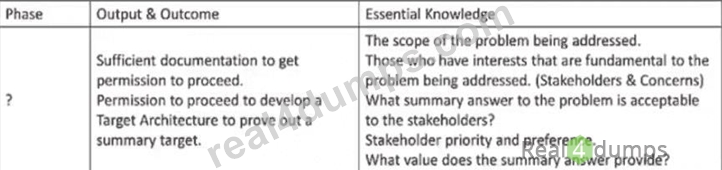
Which ADM Phase does this describe?
- A. Phase B
- B. Phase A
- C. Phase C
- D. Preliminary Phase
Answer: A
Explanation:
Phase B of the ADM cycle is the Business Architecture phase. It describes the development of a Business Architecture to support an agreed Architecture Vision. The objectives of this phase are to describe the baseline and target Business Architecture, identify candidate Architecture Roadmap components based on gaps between the baseline and target, and determine whether an incremental approach is required. Reference:
The TOGAF Standard | The Open Group Website, Section 3.2.2 Phase B: Business Architecture.
NEW QUESTION # 135
You are working as an Enterprise Architect within an Enterprise Architecture (EA) team at a large government agency with multiple divisions. The agency has a well-established EA practice and follows the TOGAF standard as its method for architecture development. The government has mandated that the agency prepare for an "AI-first" world.
The agency wants to determine the impact and role of AI in its future services. The CIO has approved a Request for Architecture Work to explore the use of AI in services. Some leaders are concerned about reliance on AI, security, and employees' need to acquire new skills.
The EA team leader seeks suggestions on managing the risks associated with a new architecture for the AI- first project. Based on the TOGAF standard, which of the following is the best answer?
- A. Create an organization map to show the links between different agency parts. Hold a meeting to teach stakeholders to interpret the models. Manage risks as part of Security Architecture development.
- B. Identify key stakeholders and develop a Communication Plan that addresses their needs. Ensure the architecture addresses risk management and summarizes features of the architecture.
- C. Separate stakeholders into groups and categorize them. Develop models for each group and verify that their concerns are addressed in Phase G, Implementation Governance.
- D. Conduct an analysis of stakeholders, documenting their concerns and recording them in the Architecture Vision document. Risks should be recorded in the Architecture Requirements Specification and reviewed regularly.
Answer: D
Explanation:
In the context of the TOGAF standard, stakeholder management and addressing stakeholder concerns are critical components, especially for high-impact initiatives like adopting an AI-first approach. Here's why the selected answer aligns best with TOGAF principles and the scenario:
* Stakeholder Analysis and Engagement:Conducting a stakeholder analysis is essential as it helps identify and document the concerns, issues, and cultural factors influencing each stakeholder group.
This aligns with TOGAF's emphasis on understanding and managing stakeholder concerns, particularly in the Preliminary and Architecture Vision phases of the ADM (Architecture Development Method).
Since the scenario highlights diverse concerns about AI, understanding each group's unique perspective will help the EA team tailor the architecture to address these effectively.
* Architecture Vision Document:By documenting these concerns in the Architecture Vision document, the EA team can provide a clear, high-level representation of how AI will be adopted, its benefits, and how it addresses specific stakeholder concerns. This is critical for communicating the intent and value of the AI-first approach in a way that aligns with the agency's strategic goals, including addressing apprehensions about job security, skill development, and cyber resilience.
* Risk Management and Architecture Requirements Specification:TOGAF highlights the importance of identifying and managing risks early in the process. By documenting the requirements related to risk in the Architecture Requirements Specification, the EA team ensures that these concerns are formally integrated into the architecture and addressed throughout the ADM phases. Regular assessments and feedback loops will provide a mechanism for continual risk monitoring and adjustment as the AI-first initiative progresses.
* Alignment with TOGAF's ADM Phases:The approach specified aligns with TOGAF's guidance on managing risk and stakeholder concerns during the early ADM phases, specifically Architecture Vision and Requirements Management. In these phases, the framework emphasizes identifying and addressing risks associated with stakeholders' concerns to build a resilient and widely accepted architecture.
* Reference to TOGAF Stakeholder Management Techniques:TOGAF's stakeholder management techniques underscore the importance of understanding and addressing stakeholder needs as a foundational step. This involves assessing the influence and interest of various stakeholders and integrating their views into architectural development, ensuring that the architecture aligns with both business goals and operational realities.
In conclusion, by conducting a thorough stakeholder analysis and documenting concerns in both the Architecture Vision and Architecture Requirements Specification, the EA team can ensure that stakeholder concerns are addressed, that the architecture supports AI adoption effectively, and that potential risks are managed proactively. This approach will foster acceptance among stakeholders and ensure that the architecture aligns with the agency's strategic goals and risk management requirements as recommended by TOGAF.
NEW QUESTION # 136
......
It is possible for you to easily pass OGEA-103 exam. Many users who have easily pass OGEA-103 exam with our OGEA-103 exam software of Real4dumps. You will have a real try after you download our free demo of OGEA-103 Exam software. We will be responsible for every customer who has purchased our product. We ensure that the OGEA-103 exam software you are using is the latest version.
Reliable OGEA-103 Test Topics: https://www.real4dumps.com/OGEA-103_examcollection.html
- Simplest Format of The Open Group OGEA-103 Exam PDF Practice Materials 🤿 Download ▷ OGEA-103 ◁ for free by simply searching on ⇛ www.prepawaypdf.com ⇚ 🦍OGEA-103 Exams Collection
- Valid Test OGEA-103 Test 👧 Valid OGEA-103 Exam Labs 👌 Valid OGEA-103 Exam Labs 💖 Search for ▷ OGEA-103 ◁ on ➡ www.pdfvce.com ️⬅️ immediately to obtain a free download 🔸Pdf OGEA-103 Version
- Pass Guaranteed Quiz OGEA-103 - High-quality Examcollection TOGAF Enterprise Architecture Combined Part 1 and Part 2 Exam Dumps Torrent 🤼 Open ( www.pdfdumps.com ) and search for ➥ OGEA-103 🡄 to download exam materials for free 🏹OGEA-103 Exam Dumps Demo
- Pass Guaranteed Quiz OGEA-103 - High-quality Examcollection TOGAF Enterprise Architecture Combined Part 1 and Part 2 Exam Dumps Torrent 🐗 Search for ( OGEA-103 ) and download exam materials for free through ➥ www.pdfvce.com 🡄 🤑OGEA-103 Exam Overview
- Quiz The Open Group - Efficient Examcollection OGEA-103 Dumps Torrent 📧 Enter ➠ www.prepawaypdf.com 🠰 and search for ▶ OGEA-103 ◀ to download for free 💅OGEA-103 Dumps Vce
- Reliable OGEA-103 Dumps 🛄 Pdf OGEA-103 Version 🌝 OGEA-103 Test Preparation 🦳 Open website 《 www.pdfvce.com 》 and search for ➽ OGEA-103 🢪 for free download 👬OGEA-103 Certification Book Torrent
- OGEA-103 Dumps Vce ⛴ New OGEA-103 Dumps Sheet 😏 OGEA-103 Exam Overview 🍓 Easily obtain free download of ➤ OGEA-103 ⮘ by searching on ☀ www.pdfdumps.com ️☀️ 😙Valid OGEA-103 Mock Test
- OGEA-103 exam preparation, real The Open Group test dumps for TOGAF Enterprise Architecture Combined Part 1 and Part 2 Exam ↔ Go to website [ www.pdfvce.com ] open and search for ⏩ OGEA-103 ⏪ to download for free 🎿New OGEA-103 Dumps Sheet
- The Open Group OGEA-103 Practice Exams for Thorough Preparation 🧫 Open ➡ www.practicevce.com ️⬅️ and search for 《 OGEA-103 》 to download exam materials for free 🐇OGEA-103 Interactive Practice Exam
- Pass Guaranteed 2026 The Open Group OGEA-103 Pass-Sure Examcollection Dumps Torrent 💻 Easily obtain 《 OGEA-103 》 for free download through ⮆ www.pdfvce.com ⮄ 😚New OGEA-103 Test Questions
- The Open Group OGEA-103 Practice Exams for Thorough Preparation 🏥 Search on ➽ www.prepawayete.com 🢪 for 《 OGEA-103 》 to obtain exam materials for free download 🔉Exam Dumps OGEA-103 Zip
- www.stes.tyc.edu.tw, myportal.utt.edu.tt, myportal.utt.edu.tt, myportal.utt.edu.tt, myportal.utt.edu.tt, myportal.utt.edu.tt, myportal.utt.edu.tt, myportal.utt.edu.tt, myportal.utt.edu.tt, myportal.utt.edu.tt, myportal.utt.edu.tt, myportal.utt.edu.tt, myportal.utt.edu.tt, myportal.utt.edu.tt, myportal.utt.edu.tt, myportal.utt.edu.tt, myportal.utt.edu.tt, myportal.utt.edu.tt, myportal.utt.edu.tt, myportal.utt.edu.tt, myportal.utt.edu.tt, www.stes.tyc.edu.tw, myportal.utt.edu.tt, myportal.utt.edu.tt, myportal.utt.edu.tt, myportal.utt.edu.tt, myportal.utt.edu.tt, myportal.utt.edu.tt, myportal.utt.edu.tt, myportal.utt.edu.tt, myportal.utt.edu.tt, myportal.utt.edu.tt, www.stes.tyc.edu.tw, myportal.utt.edu.tt, myportal.utt.edu.tt, myportal.utt.edu.tt, myportal.utt.edu.tt, myportal.utt.edu.tt, myportal.utt.edu.tt, myportal.utt.edu.tt, myportal.utt.edu.tt, myportal.utt.edu.tt, myportal.utt.edu.tt, habisbelajar.com, myportal.utt.edu.tt, myportal.utt.edu.tt, myportal.utt.edu.tt, myportal.utt.edu.tt, myportal.utt.edu.tt, myportal.utt.edu.tt, myportal.utt.edu.tt, myportal.utt.edu.tt, myportal.utt.edu.tt, myportal.utt.edu.tt, www.stes.tyc.edu.tw, Disposable vapes
P.S. Free 2025 The Open Group OGEA-103 dumps are available on Google Drive shared by Real4dumps: https://drive.google.com/open?id=1FcL2xbwgpNbk0qlQt86ewOm_U_AO7Mqc
Tags: Examcollection OGEA-103 Dumps Torrent, Reliable OGEA-103 Test Topics, OGEA-103 Reliable Exam Question, New OGEA-103 Exam Test, OGEA-103 Practice Tests