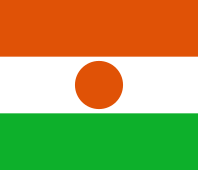
Jamhuriyar Nijar
Republic of Niger
★

├┈┈┈┈┈┈┈┤
★ FAST NATION FACTS ★


├┈┈┈┈┈┈┈┤
★

LIBERATED
August 3rd, 1960
★
ESTABLISHED
December 18, 1958
★
‘BEEN AROUND
5th century BC (Sahel)
★
SPEAKS
Official language: French
Native languages: Arabic, Buduma, Fulfulde, Gourmanchéma, Hausa, Kanuri, Zarma, Songhai, Tamasheq, Tassawaq, Tebu
★
Niamey
-Capital
-Largest city
★
APPROXIMATELY
24,112,753 national population
★
UNITARY SEMI-PRESIDENTIAL REPUBLIC
Government
★
Costus Spectabilis
National flower
★
DAMA GAZELLE
National animal
★
CURRENCY
WEST AFRICAN CFA FRANC (XOF)
★
BORDERS
Libya (northeast) Chad (east) Nigeria (south) Benin and Burkina Faso (southwest) Mali (west) Algeria (northwest)
★
12,900
Active army personnel
★
▂▂▂▂▂▂▂▂▂▂▂▂▂▂▂▂▂▂▂▂▂▂▂

▂▂▂▂▂▂▂▂▂▂▂▂▂▂▂▂▂▂▂▂▂▂▂
SEASONS
hot, dry springs heavy and humid summers cool autumns cool winters
★
AREA
1,267,000 km (489,000 sq mi)
★
LANDSCAPE
There are also large plains in the south and hills in the north. In the extreme south, there is a tropical climate near the edges of the Niger River Basin.
★
MOUNTAINS
Aïr Mountains
Part of the West Saharan montane xeric woodlands ecoregion, they rise to more than 1,800 m (5,900 ft) and extend over 84,000 km2 (32,000 sq mi). Lying in the midst of desert north of the 17th parallel, the Aïr plateau, with an average altitude between 500 and 900 m (1,600 and 3,000 ft), forms an island of Sahel climate which supports a wide variety of life, many pastoral and farming communities, and dramatic geological and archaeological sites. There are notable archaeological excavations in the region that illustrate the prehistoric past of this region. The endangered painted hunting dog once existed in this region, but may now be extirpated due to human population pressures in this region.
★
RIVERS
⒈ Niger River
★
ASSETS
Export Agriculture
Uranium Ore.
★
NATURAL DISASTERS
Flooding
Landslides
Pollution
Deforestation
Overpopulation
Lowest Literacy Rate
★
▂▂▂▂▂▂▂▂▂▂▂▂▂▂▂▂▂▂▂▂▂▂▂
 ▂▂▂▂▂▂▂▂▂▂▂▂▂▂▂▂▂▂▂▂▂▂▂
├┈┈┈┈┈┈┈┤
★ The ★
★ Personification ★
├┈┈┈┈┈┈┈┤
★
Hama Diori
“ Truly"
★
NICKNAMES
Ny River boy Nee Big Bro Jher-chan
★
GENDER
Male
★
SEXUALITY
Demisexual
★
PHYSICAL AGE
19
★
WEIGHT
56kg
★
HEIGHT
163.8 cm
★
(No, or # ofpets)
2; A camel that he rides from place to place and A stray sand cat that comes in his yard from time to time (Neko!Niger)
Recurring Phrases
⌜⌜Fofo⌟⌟
⌜⌜I see⌟⌟
⌜⌜How is the heat?⌟⌟
⌜⌜Salam-u-laikum⌟⌟
Anime Archetype
Dandere, Type A Oniichan
(physical trait/quirk, short explanation)(
▂▂▂▂▂▂▂▂▂▂▂▂▂▂▂▂▂▂▂▂▂▂▂

▂▂▂▂▂▂▂▂▂▂▂▂▂▂▂▂▂▂▂▂▂▂▂
EYES
Dark brown with a black tint
★
FACE
Oval-shaped but high-cheekbone and with persistent dark circles under his eyes.
★
HAIR
Dark brown, nearly black. Naturally coily. It always kept short and under his turban-style hat.
★
BUILD
Thin and bony but finely muscled and possessing muscle strength due to military influence
★
POSTURE
Has a tendency to slouch when sitting but stands with a straight, military posture. Tends to have closed-off body language.
★
GAIT
Takes smaller steps, Watch where he's heading.
★
HEALTH ISSUES
 Easily sick due to economy
Suffers from mild osteoarthritis
always hungry
paranoia and anxiety
depression
★
ATTIRE
Typically wears a bobo that comes down to his ankles and is a whitish color. When he is on military duty, He wears a camo army uniform. On formal occasions requiring traditional attire, a long gown similar to the boubou. The rest of the time, he wears long pants and t-shirts or button-up shirts. Never bare-headed
★
PROMINENT SCARS
Has a faded scar on his cheek from the Battle of Kousséri
Faded burns on his arms from attacks from Boko Haram
Scars and cuts on his hand from overworking
★
★
VOICE
Quiet and somewhat dry from underuse. Still a bit high due to being physically younger.
★
ACCENT
He developed a France accent due to being raised by France
★
JapaneseDialect
Hokkaido dialect
GOOD HABITS
Hardworking and honest
Polite and respectful
Peacekeeping
Unfailingly loyal and protective.
★
BAD HABITS
Workaholic
Bit of pushover
Have separation anxiety
Often gets dragged into other's battles
Tends to be paranoid and timid
★
STRANGE HABITS
Hums while he works.
Falls asleep standing up at times
May comment on anything that he observes
★
▂▂▂▂▂▂▂▂▂▂▂▂▂▂▂▂▂▂▂▂▂▂▂
![✿ 커미션💫보리님 ✿ no Twitter: "[ ㅡ 아아, 그것은 짝사랑 ] 최애캐, 자캐, 관계캐 자유롭게 연성해주세요! 변형o / 커미션o /아이디표시o /재배포x #이메레스 #트레틀 #2인이메 #1인이메… "](https://pbs.twimg.com/media/EXEkrAIUMAAu6nx.png)
▂▂▂▂▂▂▂▂▂▂▂▂▂▂▂▂▂▂▂▂▂▂▂
├┈┈┈┈┈┈┈┤
★ Personality ★
├┈┈┈┈┈┈┈┤
★
loyal protective honest hardworking worrisome focused quiet serious insecure modest alert indecisive
★
⌜⌜ A man who lived on the banks of the Niger should not wash his hands with spittle. - Chinua Achebe ⌟⌟
★
SUMMARY
It's common to see Niger working with his hands on a farm or in a market. Soft-spoken, he only speaks when spoken to. He does his best to aid his fellow nations
★
His low HDI makes him feel like a failure, It still worries him that he is nothing more than a charity case to most of the bigger nations Particularly to his younger, more successful sister. With a desire to help his country, he is working several jobs like mining and farming.
★
He's also a seasoned haggler who can be stern when the situation calls for it, as in diplomatic deals to be taken seriously. Although he is somewhat of a homebody, he is quite a host, treating his guests like kings. As soon as the issue of France comes up, his attitude stiffens
★
★
⌜⌜ ⌟⌟
★
★
LIKES
Millet
Gazelles
Brochettes
Rain
Beignets
Peace
Friendship
★
DISLIKES
✗Be pitied
✗Fights
✗Noise
✗Having his name mispronounced
✗Being helpless
✗Libya
★
FAVORITES
Place to be Agadez
Food Djerma Stew
Nation Mali
Way to relax Horse-Riding
Animal Horses, Gazelle
Color Orange
Time Period Sahel Empire
★
TALENTS
horse racing guitar sorro wrestling poetry artisan bargaining
Typically, Niger's skills are agricultural and animal husbandry based due to his rural economy. Because it is an entrenched part of his culture, he is also talented with handcrafts; usually, he makes 6 textiles in a day. Despite his mild personality, he knows how to bargain quite well. Knowing every tactic. Although he tries to get involved with sport, because of his budget, he can only engage in local activities such as horse racing and soro wrestling. He plays guitar and writes poetry in his free time.
★
HOBBIES
music Football shooting horse riding
He sometimes plays football with Madagascar. He takes every opportunity to ride a horse and camel. Due to his history as a military junta, he is decent at shooting. During festivals, he plays the guitar and sings.
▂▂▂▂▂▂▂▂▂▂▂▂▂▂▂▂▂▂▂▂▂▂▂

▂▂▂▂▂▂▂▂▂▂▂▂▂▂▂▂▂▂▂▂▂▂▂
⌜⌜No nation has friends, only interests - Charles de Gaulle⌟⌟
★
├┈┈┈┈┈┈┈┤
★ Relations ★
├┈┈┈┈┈┈┈┤
★
Nigeria
His younger sister and neighbor. After growing up apart, they got along well when they met. Nige tries to be her doting older brother, but to no avail (for example, getting wrongly mistaken as a younger brother). Although he is proud of his sister's accomplishments, he feels that he failed as an older brother.
★
France
A string of guilt is still attached to the massacre of his people by the French soldiers and being viewed by others as a cause for a stop. France is his main export market and import market. Cooking was another skill he acquired in France. During WWII, Niger remained loyal to France. Today, they have a professional relationship, but Niger has difficulty understanding France sometimes
★
Tuareg
Niger still sees Tuareg as a part of him... A really rebellious part of him
★
Benin
Due to their former status as French subjects, they were close friends for many years. Despite getting along, Niger is wary of Benin's adventures in the Soviet Union
★
Chad
A good friend of his, They were both under France's rule. Chad helped him out with terrorists and is the Yang to his Yin.
★
United States of America
The default backup outsider when France isn't concerned, They have a decent relationship and besides the whole 9/11 incident, they remained loyal to each other and train together. Niger holds a slight admiration for America since he too was just a colony once
★
Senegal
Senegal was the ex-wife of his big sister. Mali and Senegal split up, but Senegal still seems to treat him as a little brother
★
China
★
Their political relationship was smooth and they had close exchanges at all levels. China retracted its friendship with Niger for his efforts to befriend Taiwan and support India during the Indo-China war. Their relationship has improved a bit but Niger is still wary
India
★
Another ally, They had a steady friendship despite the fact that it struck a nerve with China. India helped him out with getting back on track, They get together for International Day of Yoga
Mali
★
His older sister, She was under her care as a child
Italy
Italy sent him 470 Italian soldiers would be deployed to Niger in an effort to mitigate the European migrant crisis. Niger is friendly toward him but is unnerved by his "shamelessness"
★
Libya
Everything has been tense around them
★
Pakistan
Ancestors: Tichitt, Djenné-Djenno, Bura culture, Songhai
▂▂▂▂▂▂▂▂▂▂▂▂▂▂▂▂▂▂▂▂▂▂▂

▂▂▂▂▂▂▂▂▂▂▂▂▂▂▂▂▂▂▂▂▂▂▂
⌜⌜ Confront them with annihilation, and they will then survive; plunge them into a deadly situation, and they will then live. When people fall into danger, they are then able to strive for victory. - Sun Tzu ⌟⌟
★
├┈┈┈┈┈┈┈┤
★ History ★
├┈┈┈┈┈┈┈┤
Sum mary
★
EARLY INHABITANTS
Stone tools, evidence of a Paleolithic culture, indicate the presence
of humans more than 60,000 years ago in the Air, Ténéré, Djado, and Kuwar regions. The stone tools, including axes, oval disks used for cutting and scraping, and stone knives, were produced by a Neolithic
Saharan culture that domesticated bulls and herded cattle--an activity that is still practiced today by the different nomadic groups of Niger.
Artists of the Neolithic Saharan culture probably drew the numerous rock paintings that are often found north of Agadez.
THE SAVANNAH KINGDUMS
THE ZAGHAWA KINGDOM was located around the Chad Basin from A.D. 700 to 1100 and occupied the North Kanem region, northeast of Lake Chad. The term Zaghawa does not refer to a specific culture or period but to the pre-Islamic black inhabitants of the region. The Zaghawa were the first to acquire the skill to cast iron, make crafts, and provide services to the nomadic and sedentary groups around Kanem. They relied on agriculture, fishing, and making crafts for a living, and in a later period, they engaged in international trade, which included slaves, with the Muslim states of North Africa and the Middle East. An economic transformation led to the rise of the Kanem Empire after the 12th century.
THE HABASHA KINGDOM was predominantly made out of Chadic speakers, who lived on the river valleys around the same time as the Zaghawa. Similar to the Zaghawa, the Habasha traded and sold their agricultural produce as well as other crafts and were not just subsistence farmers. Most were cattle herders and salt traders. The Habasha did not have territorial aspirations.
SILENT AUCTION
Southern Niger was part of west Sudan when gold was traded between the Muslim and Sudanese traders. Although the Muslim traders were involved in the gold trade, their Sudanese counterparts supplied them with little information about the location of the gold mines. Muslim geographers used to say that gold grew in the sand of Sudan as carrots did.
The Sudanese had an equally unusual trading relationship with their gold suppliers from the gold-producing center in the south of Niger. Known as the silent auction, this method of barter illustrated their peculiar trading customs. The Sudanese traders would place their merchandise, mainly salt bars from the Sahara, in piles on the bank of the river and then retreat.
Afterward the local people would appear with their gold and would place some gold next to each pile of merchandise and then withdraw. The traders would return to the riverbank and take the gold if the amount placed against each pile satisfied them. They would then disappear. The local people would emerge from their hiding places and go to the riverbank to collect the merchandise they had bought.
As the Zaghawa kingdom expanded to the west, the Habasha kingdom contracted into the kingdoms of Gobir and Katsina. As the Mbau tribe on the southern border developed, the Habasha joined them to form what was later known as the Mbau kingdom. The term Mbau refers to the original inhabitants of the savannah region between Niger and Nigeria. Although traces of their history are found today in the numerous village names, their language is now almost extinct. The Mbau people were much feared for their raids.
Toward the seventh-century A.D.., the first Songhai and Kanem states appeared in the western and the eastern parts of Niger, respectively. From the core of Mali, the Songhai Empire expanded its territory along the Niger
THE SONGHAI EMPIRE was one of the greatest empires of West Africa. Its dominance reached a peak when Sonni Ali took power and lasted more than 100 years.
The dominant individuals of the Songhai were the Sorko fishermen. Known as the masters of waters, the Sorko navigated the waters of Niger River from Dendi, reaching places north of Tillabéry.
A cohesive and important political organization was born among them, resulting in the first Songhai dynasty known as the Dya. By the eighth century A.D., increased economic relations with the Kharedjite Tahert state in western Algeria strengthened the Songhai kingdom.
The city of Gao became the commercial center and the residence of the Songhai rulers. Kukiya, southeast of Gao, remained the ancestral capital, where festivals and royal celebrations took place.
Around the mid-12th century the Empire of Mali attempted to extend its rule over all Saharan trade route terminals. However, as a remote province, Songhai attempted to gain its independence amid periods of weakness in Mali. Under the leadership of Ali Kolon, the new dynasty of the Sonni was founded.
But it was not until the beginning of the 15th century that the Songhai Empire started to build its military power and begin expansion under the rule of Sonni Ali the Great (1464-92).
Spreading westward, it conquered Timbuktu in 1469 and Jene in 1473. As the Empire of Mali retreated south of the Niger Delta, having lost its Sahelian territory, the Songhai Empire, during the rule of Askia Muhammad (1493–1528), took over additional provinces that had been part of Mali. It also conquered the Berber city of Agadez and the Hausa states on the southern border of today's Niger. The end of the 15th century saw the destruction of the Songhai Empire when the North African empire of Morocco conquered its territory.
River, while the Kanem Empire concentrated its rule around Lake Chad and extended its conquest north to the Fezzan in Libya. In between the two empires, smaller states, such as the Hausa states, emerged. Around A.D. 1000, an increase in economic relations with North Africa via the Air region led to migrations of Tuareg from Libya and Algeria toward the Air and adjacent regions. At this time, both the Songhai and Kanem empires adopted Islam as their religion. Meanwhile, the Hausa, who previously lived in the north, gradually moved south.
THE EMPIRE OF BORNU benefited greatly from the collapse of the Kanem Empire. The latter empire fell due to the lack of resources, royal rivalry, and internal conflicts, which erupted in the mid-13th century. Even before the collapse of Kanem, parts of Bornu had become independent, especially after the Bornu economy started to benefit from the direct trans-Saharan trade route to North Africa. In the 14th century, when the Suffewa rulers started to encounter opposition from the Bulala, a rival dynasty, the Suffewa rulers and their followers left Kanem and headed toward Bornu, where they had long before placed lords.
Even though the Suffewa fled from Kanem, their conflict with the Bulala continued for many years. The Suffewa later solved their internal problems and regained strength and security from 1465 to 1497 under the rule of Ali Dunama, also called Ghaji "the Younger." He was able to resolve the struggle for the throne between the different branches of the Suffewa. In addition, Ali Ghaji ended the threat of the Bulala once and for all and laid the foundation of a new and powerful Suffewa Mais dynasty, with its capital at Ngazargamu. The Suffewa in Bornu saw in Islam a powerful means of strengthening their authority over the Bomu lands. As the different groups accepted Islam, stability was restored.
In the 16th century the region that was to become Niger was greatly influenced by the Songhai and Bornu empires. The Bornu Empire reached its apex under the rule of Idris Alauma (1564-76). The acme of Songhai rule occurred during the reign of Askia Mohammed (1493--1528). In 1498 Askia Mohammed went on a pilgrimage to the Muslim holy city of Mecca. On completing his pilgrimage to Mecca, he received the two honored titles-- al Hajj and the Caliph of the Western Sudan-which increased his support among the Songhai Muslims and helped consolidate his rule. The Songhal Empire was destroyed by Moroccans who came to search for the gold of Sudanic Africa, and who wanted to control the trade routes. The Battle of Tondibi in 1591 was a heavy loss for the Songhai; it was their
★
★Full History of Niger ★
▂▂▂▂▂▂▂▂▂▂▂▂▂▂▂▂▂▂▂▂▂▂▂
▂▂▂▂▂▂▂▂▂▂▂▂▂▂▂▂▂▂▂▂▂▂▂
★
├┈┈┈┈┈┈┈┤
★ Obligatory Ending Theme ★
├┈┈┈┈┈┈┈┤
Marukaite Chikyuu
Fofo Papa, can we have Lemu-hari!
Fofo Mamma, Fofo Mamma!
I can't get the taste of that millet porridge
We ate long ago out of my head!
Draw a circle, that's the Earth!
Draw a circle, that's the Earth!
Draw a circle, that's the Earth!
I'm Niger!
Draw a circle, that’s the Earth!
Look at it, that’s Earth!
Or could it be the Earth?
I'm Niger!
Ah! You can see the
Magnificent world with just one stroke
Let's wrap the world in a hand-weavened blanket!
("Another drought passed by, It was supposed to be rain season")
Draw a circle, that’s the Earth!
Draw a circle, that’s the Earth!
Draw a circle, that’s the Earth!
I'm Niger!
Draw a circle, that’s the Earth!
Suddenly, there’s the Earth!
Lie on your back, there's the Earth!
I'm Niger!
Ah, with just some boiling,
A recipe that will make you cry with joy
("The kilishi is almost ready.")
The sun continues to beat down!
Hey, hey, ƙane, pass me the massa!
While you're at it, 'yar'uwar, please fry it!
Oi, oi, kakan, I am at peace.
Fofo, Fofo (is that for me?)
Fofo Papa, can we have Lemu-hari!
Fofo Mamma, Fofo Mamma!
I can't get the taste of that millet porridge
We ate long ago out of my head!
Even as the lowest HDI, Even I can flourish!
Draw a circle, that’s the Earth!
Draw a circle, that’s the Earth!
Draw a circle, that’s the Earth!
I'm Niger!
Ah! You can see the
Fabulous world with just one stroke
The land once boomed with business and fauna
Niger!
Ah, throughout the world,
Sleeps the recipe of happiness
The land is shaky and ever changing!
But I'll do my best
Hatafutte Parade
In my right hand is a fabric!
In my left hand is brochettes~!
Wave your flag, wave your flag, it's a daga tuta parade!
Towards the enchanting world, mu tafi!
Take our hands, make a circle, spin, and it's the world
With a rainy season, I'm in the best condition!
kore, fari, lemo mai zaƙi make my tricolor
Even when dragged down, I must do my best
He-ta-li-a
"Ugh, I'm always forgotten...
The only time I'm mentioned is with Nigeria
Or with that other word"
Another great day, it's a daga tuta parade
Sound your instruments, it's time to march
If everyone at one-two makes the ensemble, the one and only song will be complete
Playing the guitar is me, Niger~!!
"But, I need to hurry and get back to work~"
The River flows through us all
Bissap will wash all the strife away
As the world continues to shift and shake, I still stay in place
(Tashi! Nijar! Tashi!
Tashi! Nijar! Tashi!)
Tashi! Nijar! Tashi! Even a barren desert
Tashi! Nijar! Tashi! Can be home to a gold
Tashi! Nijar! Tashi! The loud cheers keep growing passionate
Tashi! Nijar! Tashi!
"It's fine, I'm sure I can manage on his own."
Wave your flag, wave your flag, it's a flag-waving parade!
This melody is universal♪
The 5 continents and the 7 seas
At this energetic tempo, they traverse each other grandly!
This is the Cure Salee that will continue towards tomorrow!
Slip through the zipper to dreams!
kore, fari, lemo mai zaƙi make my tricolor
Even when dragged down, I must do my best
He-ta-li-a
""
Hatafutte Parade
I
★This template was made by FishyFish★